
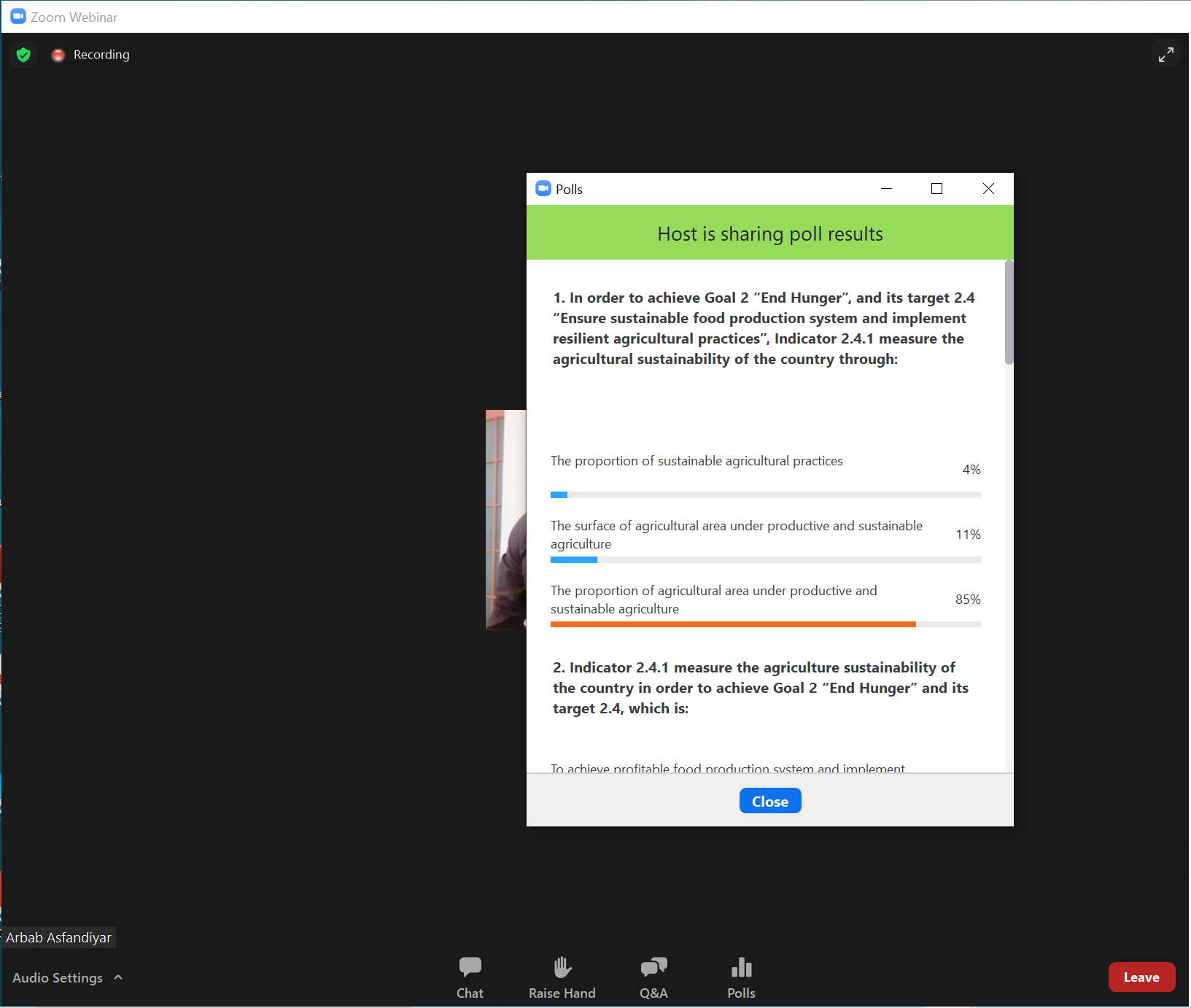
From 28 June to 1 July 2021, AFSIS Secretariat had participated in the Virtual Trainings on SDG indicator 2.4.1 “Proportion of Agricultural Area under Productive and Sustainable Agriculture” conducted by the Headquarter of Food and Agriculture Organization of the United Nations (FAO) via Zoom platform.
The countries were grouped based on the regions (i.e. time zones) and there were representatives from the different 25 countries namely Australia, Bhutan, Brunei Darussalam, Cambodia, China, Cook Islands, Fiji, India, Iran, Japan, Lao People's Democratic Republic, Malaysia, Maldives, Marshall Islands, Mongolia, Nauru, New Zealand, Palau, Philippines, Republic of Korea, Samoa, Singapore, Thailand, Timor-Leste, Vanuatu that had been trained during the session of 28 June to 1 July 2021. Also, 5 representatives from AFSIS Secretariat had also participated with a commitment to the training for at least 4 hours each day.
The objective of the training is to provide detailed training on 2.4.1 methodology, to introduce the data collection tools and instruments developed for collecting and reporting data, and to help understand and evaluate the data related to SDGs 2.4.1. The purpose of the training is also to discuss the concrete plans to collect data on the indicator in the short, medium, and long term.
During the meeting, the exercises were given by the FAO for the representatives to understand the fundamental calculation of the SDGs.2.4.1 data. Moreover, FAO had opened the discussion to have Q&A sessions from time to time for the representatives from each country in order to ask the questions and be clear on the technical terms.
This virtual training ended productively and successfully on 1 July 2021.
.png)
.png)

On 29 July 2026, the APEC Policy Partnership on Food Security (PPFS) successfully convened the APEC PPFS Webinar on Strategic Cooperation for Strengthening Food System Resilience via a virtual platform. The webinar was organized by the Ministry of Agriculture, Food and Rural Affairs (MAFRA) of the Republic of Korea as a self-funded PPFS project to promote strategic cooperation and knowledge exchange on strengthening food system resilience across APEC member economies.

The AFSIS Secretariat participated in the 10th International Conference on Agricultural Statistics (ICAS X), held from 8 to 10 July 2026 at the ICE Krakow Congress Centre in Krakow, Poland. Jointly organized by Statistics Poland, Eurostat, the United States Department of Agriculture (USDA), the World Bank Group, and the Food and Agriculture Organization of the United Nations (FAO).
.JPG)
On 24–25 June 2026, AFSIS Secretariat participated in the 46th Meeting of the ASEAN Food Security Reserve Board (AFSRB) via a virtual conference. The Meeting was jointly organized by the AFSRB Secretariat and the Department of Agriculture (DOA), Ministry of Agriculture, Livestock and Irrigation (MOALI) of the Republic of the Union of Myanmar, and was hosted in Nay Pyi Taw, Myanmar.

On 17–18 June 2026, the 24th AFSIS Focal Point Meeting was successfully convened via video conference, hosted by the Philippine Statistics Authority (PSA) in collaboration with the ASEAN Food Security Information System (AFSIS) Secretariat.

