Report and Disseminate the Information Regarding
the Serious Disaster
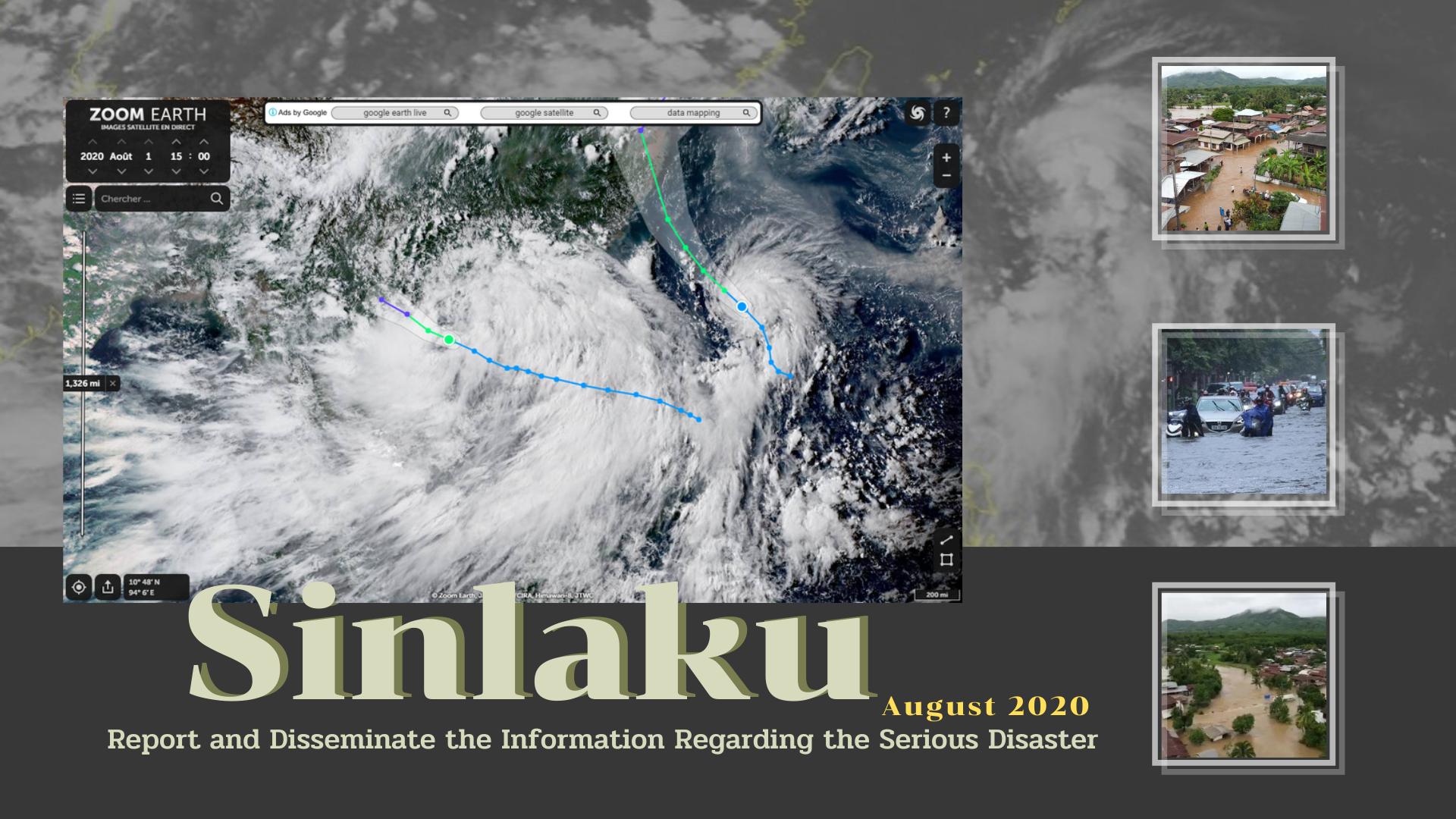
Tropical Storm Sinlaku
August 2020
Note: This information is collected by AFSIS through related organizations and media.
For more information, please contact the policy department in each country.
Lao PDR
Sinlaku, the Tropical Strom, hit many areas in Lao PDR. The storm damaged 3 provinces in Northern region; Xayaboury, Luangnamtha and Oudomxay and a province in Central region; Borikhamxay. Furthermore, the expected area that damaged and expected to be damaged from the storm is estimated around 279.32 hectares for rice and 201 hectares for crops.
The Tropical Storm were affected the planted areas which is estimated around 3,620 tons of rice and 2,308 tons of crops. It cost around 52,927,500 Kip or 5,833 USD for the country.
Base on Agriculture, Forestry Development plan in 2020 in term of food security prevention,a reserve to guarantee food in case of disaster for up to 3 months (400,000 tons of rice) will be build, and emergency assistance for agriculture and livestock to the affected provinces, such as seeding, Bleeding and production factors will be provided for the affected areas or provinces.
Thailand
Several provinces in Northern and Northeastern regions of Thailand have been hit by Tropical Storm Sinlaku. This storm made flash flood damage in some rice fields in 9 provinces; Phrae, Uttaradit, Nan, Lampang, Chiang Rai, Mae Hong Son, Chiang Mai, Lei and Nong Bua Lam Phu province. The damage was insignificant because the flood drained rapidly.
Sinlaku caused torrential rains, strong wind and flash flood triggered in several areas of Northern and Northeastern Thai. The damaged areas are estimated around 9,199.92 hectares containing wet season rice 5,827.12 hectares (0.06% of planted area), farm plant 1,638.24 hectares and other 1,734.56 hectares. However, more areas along the Chao Phraya River can be more cultivated because the water level of the Sirikit dam has increased. In the result, the planted area in Thailand is slightly increased by the farmer’s high motivation due to the high paddy farmgate prices and government policy.
Minister of Agriculture and Cooperatives has commanded regional offices of Agricultural Extension Department to monitor the damaged that may affect the food security in the countries and provided subvention to the farmers.
Vietnam
In 2020, Vietnam was hit by 2 Tropical Strom Nuri and Sinlaku. The Tropical Strom Sinlaku is the 2nd storm on beginning of August. Affected areas of Sinlaku storm in Vietnam are North-Central and Northern Delta regions, particularly Thai Binh, Nghe An, Ninh Binh, Nam Dinh, Thanh Hoa provinces.
Sinlaku storm caused heavy rains on a large scale, resulting in floods in some areas. However, it is indicated that although heavy rains affected some crops including newly transplanted rice, the damaged areas are negligible. Meanwhile, due to prolonged droughts in many North-Central provinces for several months, rains due to the effect of the Sinlaku circulation were likely to be beneficial for some crops in those areas. Fortunately, there is no further detail information about planted areas or quantities of agricultural crops affected by the Sinlaku storm in Vietnam.
In order to protect agricultural production, Ministry of Agriculture and Rural Development actively implemented plans to cope with possible impacts of the storm on crop production.
Word File : AFSIS SINLAKU

The AFSIS Secretariat participated in the 10th International Conference on Agricultural Statistics (ICAS X), held from 8 to 10 July 2026 at the ICE Krakow Congress Centre in Krakow, Poland. Jointly organized by Statistics Poland, Eurostat, the United States Department of Agriculture (USDA), the World Bank Group, and the Food and Agriculture Organization of the United Nations (FAO).
.JPG)
On 24–25 June 2026, AFSIS Secretariat participated in the 46th Meeting of the ASEAN Food Security Reserve Board (AFSRB) via a virtual conference. The Meeting was jointly organized by the AFSRB Secretariat and the Department of Agriculture (DOA), Ministry of Agriculture, Livestock and Irrigation (MOALI) of the Republic of the Union of Myanmar, and was hosted in Nay Pyi Taw, Myanmar.

On 17–18 June 2026, the 24th AFSIS Focal Point Meeting was successfully convened via video conference, hosted by the Philippine Statistics Authority (PSA) in collaboration with the ASEAN Food Security Information System (AFSIS) Secretariat.
.jpg)
The ASEAN Food Security Information System (AFSIS) Secretariat, in collaboration with the Ministry of Agriculture, Forestry and Fisheries (MAFF) Japan, Japan Aerospace Exploration Agency (JAXA), Remote Sensing Technology Center of Japan (RESTEC), and Geo-Informatics and Space Technology Development Agency (GISTDA), conducted the 2nd Hands-on Training Courses for Agricultural Statisticians, the Final Workshop, and the 2nd Seminar for Executive Officials under the JAIF Project entitled “Improvement of Rice Paddy Area Statistics and Damage Assessment using Earth Observation Satellites for ASEAN” in Sriracha, Chonburi Province, and Bangkok, Thailand.

