
Assessing Food Security in ASEAN through Self-Sufficiency Ratios: A Comparative Analysis of Major Agricultural Commodities
The Self-Sufficiency Situation (SSR) on Major Commodities
As AFSIS compiles data from ASEAN countries (Southeast Asia), it monitors food security levels of major agricultural commodities across ASEAN region, including rice, maize, sugarcane, soybean, and cassava. The data emphasizes variations in commodity importance among countries, depending on their agricultural production capacities. These agricultural commodities serve as the backbone of ASEAN’s economy, which is a primarily resources of livelihood, food security and importantly export for the region 1. Recently, ASEAN’s agricultural production is dominated by staple crops such as rice and maize, which are widely produced and consumed. Meanwhile, other crops, such as cassava and sugarcane, play important roles as industrial and export-oriented commodities, especially for animal feed and food processing, due to rising demand driven by population and income growth. However, the region produces relatively limited soybeans and increasingly depends on imports 2.
The SSR is an important indicator of food security. In the basic definition, it is used in measuring the extent to which a country can meet its food needs through domestic production relative to domestic consumption 4. For a practical use of SSR defined by AFSIS, it is typically calculated as the ratio of domestic production to domestic utilization. The SSR above 100% indicates self-sufficient and surpluses production, while values below 100% indicate deficit or dependence on imports. While a high SSR suggests greater independence from imports and stronger national food availability, the SSR alone does not fully capture food security, such as access, affordability, and stability of supply. Those key food securities are also critical factors. Therefore, an SSR should be used alongside other indicators to provide a more comprehensive understanding of a country’s food security situation 3-4.
A Serious Situation Impacting to Commodities
Food insecurity is also a major concern. Agricultural commodities are generally influenced by several factors that affect both production and consumption. These factors can lead to significant price volatility at both domestic and global levels. On the supply side, production is affected by weather conditions, climate variability, input costs (such as fertilizer, fuel, and labor), technological advancements, and government policies. On the demand side, population growth, income changes, dietary shifts, and the expansion of biofuel industries play significant roles in shaping consumption patterns. In addition, global trade dynamics, including exchange rates, trade agreements, transportation costs, and geopolitical events, can disrupt or facilitate market flows, and lead to price fluctuations. As mentioned, these factors determine the availability, competitiveness, and stability of agricultural commodities in the global market 5.
The SSR across ASEAN Countries
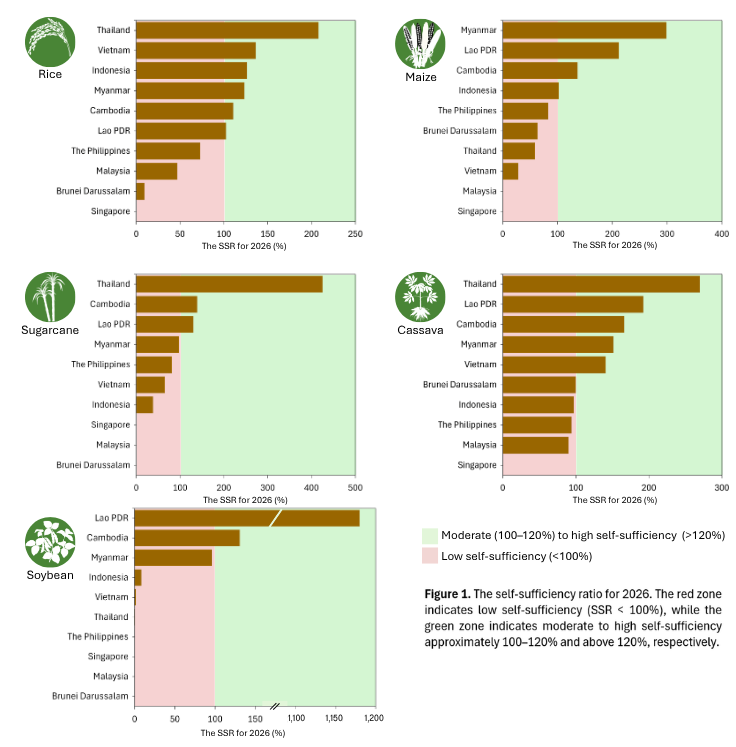
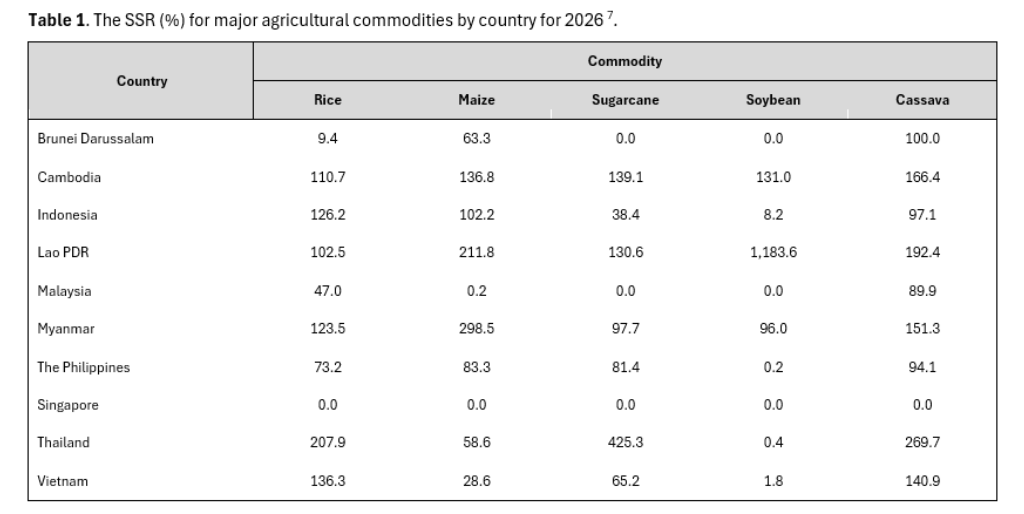
The SSRs across ASEAN countries reveal clear differences in production capacity by commodity. Most countries are self-sufficient for rice, with Thailand, Vietnam, Indonesia, Myanmar, Cambodia, and Lao PDR producing more than their domestic requirements (Table 1 and Figure 1). In contrast, the Philippines, Malaysia, and Brunei Darussalam remain import-dependent, while Singapore indicates that rice as a relatively strong and stable commodity in the region, particularly among mainland ASEAN countries.
The pattern is more uneven for maize and sugarcane. Countries such as Myanmar, Lao PDR, and Cambodia show strong maize surpluses, while Thailand dominates sugarcane production with an exceptionally high SSR, followed by Cambodia and Lao PDR (Table 1). However, several countries, including Malaysia, Vietnam, and the Philippines, are not self-sufficient in these commodities, indicating continued reliance on imports (Table 1 and Figure 1). In many cases, production is concentrated in only a few countries, which creates an imbalance within the region.
In the case of soybean, most ASEAN countries are highly import-dependent, with very low SSR values. Only Lao PDR and Cambodia exhibit strong self-sufficiency, while Myanmar is near balance. As mentioned, the strong SSR for soybean in Lao PDR is due to the country having very low domestic consumption compared to its production, and the absence of processing facilities for soybean products, and soybean in Lao PDR is primarily exported rather than consumed domestically. However, this does not necessarily reflect strong food security, but rather limited domestic utilization. The rest of the region shows minimal domestic production, including Indonesia, Vietnam, Thailand, and the Philippines (Table 1 and Figure 1). The result reflects structural limitations in soybean cultivation and a heavy reliance on external supply.
For cassava, several countries demonstrate strong export potential as they have high SSR levels, particularly Thailand, Lao PDR, Cambodia, Myanmar, and Vietnam (Table 1 and Figure 1). Indonesia, the Philippines, and Malaysia are close to self-sufficiency (Table 1 and Figure 1) but still slightly dependent on imports, while Brunei Darussalam is fully self-sufficient and Singapore has no production.
Overall, mainland ASEAN region tends to have higher SSRs and surplus capacity across multiple commodities, whereas some countries remain more dependent on imports, especially for major agricultural commodities.
The SSR at the Regional Level
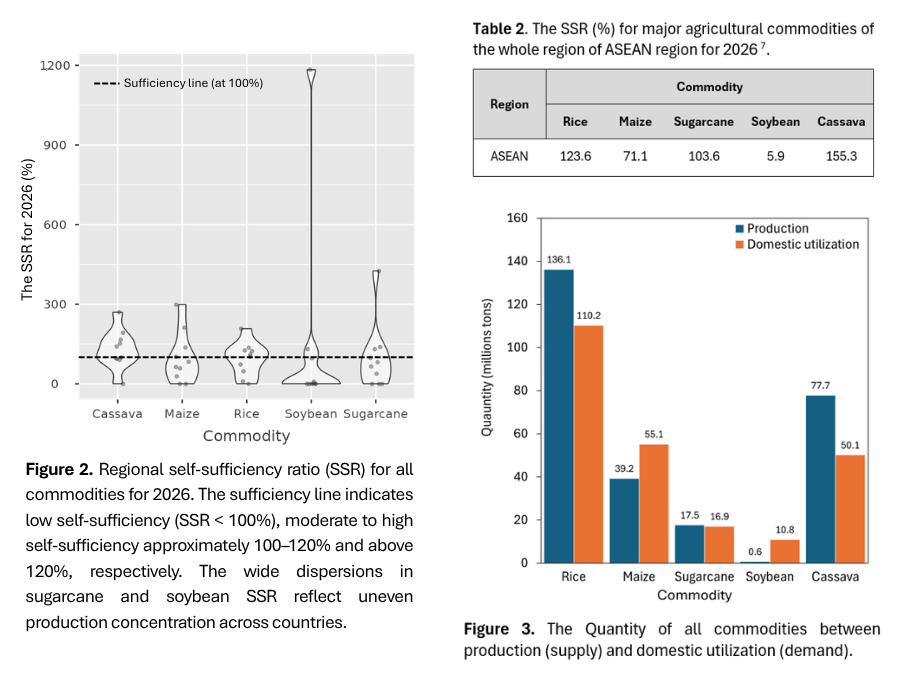
At the regional level, ASEAN region shows varying degrees of self-sufficiency across major agricultural commodities. The region is strongly self-sufficient in rice, with an SSR of 123.6% (Table 2). It indicates that total production exceeds domestic utilization and allows for export or stock accumulation. Similarly, cassava exhibits a high SSR of 155.3% (Table 2), which reflects a strong surplus position and its importance as an export-oriented crop in the region. Additionally, the SSR is at 103.6% for sugarcane (Table 2).
This suggests that the region is broadly self-sufficient, with production slightly exceeding domestic demand. In contrast, maize has a lower SSR of 71.1% (Table 2 and Figure 2), which indicates that ASEAN relies on imports to meet domestic needs, particularly for feed demand in the livestock sector.
The most significant deficit is observed in soybean, with an SSR of only 5.9% (Table 2 and Figure 2). This shows a heavy dependence on imports across the region. This reflects structural constraints in soybean production and strong demand for food processing and animal feed.
Overall, while ASEAN demonstrates strong self-sufficiency in staple and industrial crops like rice and cassava, it remains import-dependent for major crops, mainly for soybean and partially for maize.
The Relationship between Supply and Demand
The relationship between production and domestic utilization directly reflects the SSR of each commodity in ASEAN. Commodities where production exceeds domestic utilization correspond to an SSR above 100% (Table 2 and Figure 3), indicating surplus and export potential. This is clearly seen in rice and cassava, where production is substantially higher than domestic use, resulting in high SSR levels. These commodities strengthen the region’s food security and position ASEAN as a key supplier in global markets.
The relatively balanced levels of production and domestic utilization translate into an SSR slightly above 100% for sugarcane (Table 2). It suggests as a general self-sufficiency. While not as strongly sufficient as rice or cassava, the region is still capable of meeting its own demand with limited reliance on imports. In contrast, maize shows production lower than domestic utilization, which corresponds to an SSR below 100%(Table 2and Figure 2–3). This indicates a structural deficit and emphasizes the region’s dependence on imports, particularly for animal feed. The insufficient situation is even more strongly observed for soybean, where the large gap between very low production and high domestic demand results in an extremely low SSR (Table 2and Figure 2–3). This reflects a heavy and persistent reliance on external supply.
In conclusion, the SSR perspective reveals that ASEAN is highly self-sufficient in rice and cassava, broadly self-sufficient in sugarcane, but remains import-dependent for maize and especially soybean. These differences emphasize the need for targeted agricultural strategies depending on the commodity.
Geopolitical Impacts on ASEAN based on the SSR
The SSR patterns in ASEAN show both resilience and vulnerability in the context of geopolitical conflicts, such as those in the Middle East 6. High SSR in rice and cassava allows the region to remain relatively secure and even support global supply during disruptions. However, low SSR in maize and especially soybean contributes ASEAN to highly dependent on imports, which exposes it to rising costs and supply uncertainties driven by conflict-related increases in energy, transport, and fertilizer prices. Rising energy prices increase fertilizer and transport costs, which can reduce production capacity and weaken SSR over time 6. Therefore, while staple food security is relatively strong, reliance on external sources for feed and protein crops remains a key risk under global instability.
For more details click download PDF file: Assessing Food Security in ASEAN through Self-Sufficiency Ratios: A Comparative Analysis of Major Agricultural Commodities
References
.JPG)
From 15–16 September 2026, the AFSIS Secretariat, in collaboration with the Japan Aerospace Exploration Agency (JAXA), Remote Sensing Technology Center of Japan (RESTEC), Ministry of Agriculture, Forestry and Fisheries (MAFF) Japan, and the Philippine Statistics Authority (PSA), conducted the “Workshop on Promote rice planted area and production estimation using space-based technologies in the Philippines” at Park Inn by Radisson North EDSA, Quezon City, Manila, the Philippines.

On 19 August 2026, the AFSIS Secretariat participated in the Special Senior Officials Meeting of the 25th Meeting of the ASEAN Ministers on Agriculture and Forestry Plus Three (Special SOM-25th AMAF Plus Three), hosted by the Philippines via video conference. The Meeting was attended by Senior Officials from ASEAN Member States, the Plus Three countries, and the ASEAN Secretariat. The AFSIS Secretariat was represented by Dr. Sumanya Ngandee, AFSIS Manager.

On 29 July 2026, the APEC Policy Partnership on Food Security (PPFS) successfully convened the APEC PPFS Webinar on Strategic Cooperation for Strengthening Food System Resilience via a virtual platform. The webinar was organized by the Ministry of Agriculture, Food and Rural Affairs (MAFRA) of the Republic of Korea as a self-funded PPFS project to promote strategic cooperation and knowledge exchange on strengthening food system resilience across APEC member economies.

The AFSIS Secretariat participated in the 10th International Conference on Agricultural Statistics (ICAS X), held from 8 to 10 July 2026 at the ICE Krakow Congress Centre in Krakow, Poland. Jointly organized by Statistics Poland, Eurostat, the United States Department of Agriculture (USDA), the World Bank Group, and the Food and Agriculture Organization of the United Nations (FAO).

