Tropical Depression Seventeen
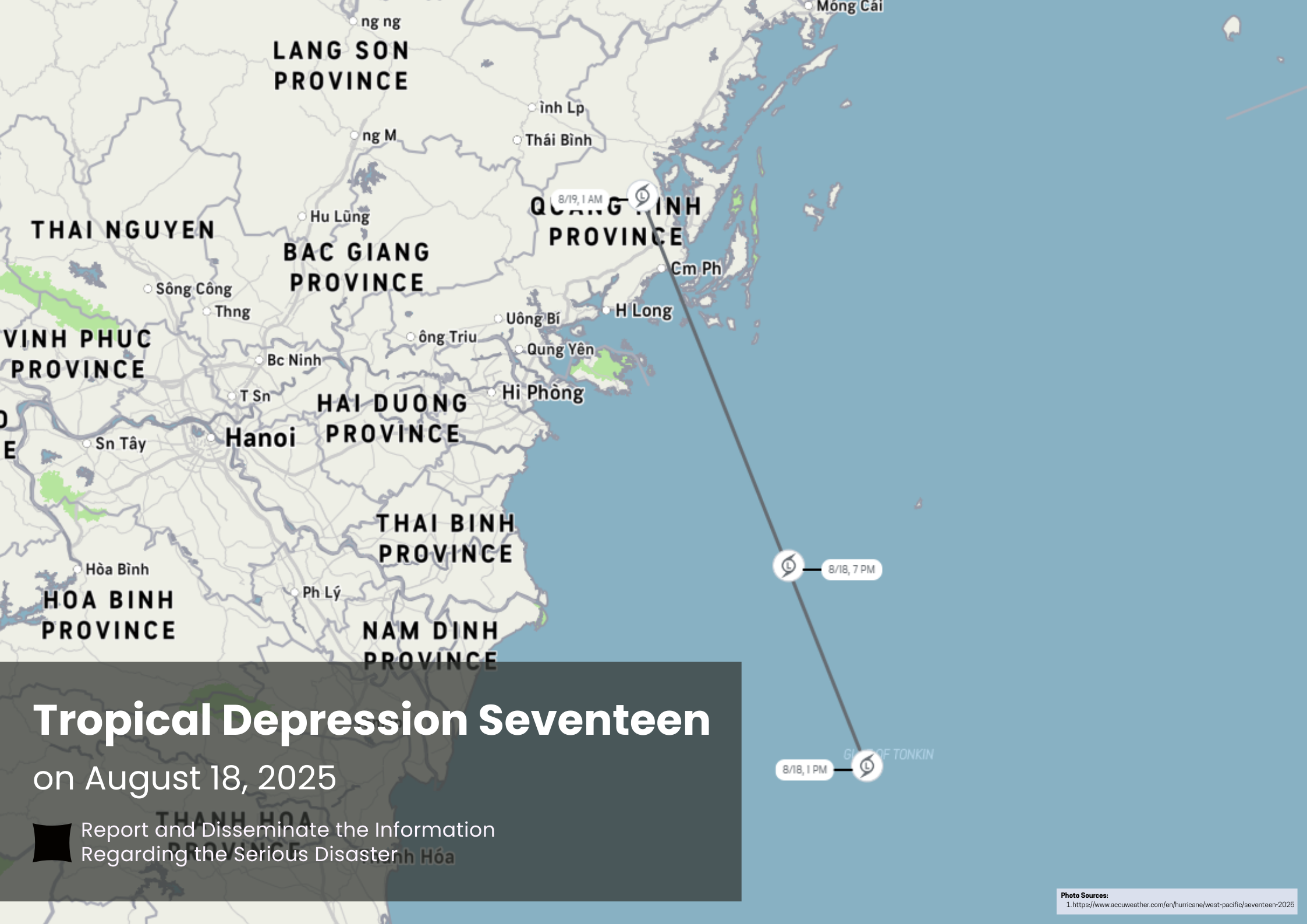
Tropical Depression Seventeen on August 18, 2025
Tropical depression seventeen was identified as INVEST 91W, a low-pressure area detected over the East Sea, according to Vietnam’s National Center for Hydro-Meteorological Forecasting (NCHMF). The report revealed that the depression had maximum sustained winds near the center at level 6–7 (approximately 39–61 km/h), with gusts reaching level 9.
On August 19, the tropical depression moved in a north-northwest direction and was later forecast to continue moving northward at 10–15 km/h, gradually weakening into a low-pressure area over Guangxi, China.
The report also warned that the depression may pose hazards to countries such as Lao PDR, Thailand, and Vietnam, potentially bringing thunderstorms, strong winds, heavy rainfall, flash floods, and mudslides in some areas.
Damage and losses
Impact on the affected area
According to reports from the Center for Agricultural Statistics (CAS), Lao PDR, officials confirmed that there was no impact on crops, livestock, or infrastructure in the country. Meanwhile, in Vietnam, the storm depression brought heavy rain and thunderstorms to several provinces, causing landslides, flooding, and damage to crops and aquaculture, according to the Department of Dyke Management and Natural Disaster Prevention and Control.
Agricultural devastation
Agricultural land:
Affected crops:
Government responses and countermeasures
No information has been reported for this situation yet.
Sources:
Download PDF file clik here: Tropical depression seventeen news

The AFSIS Secretariat participated in the 10th International Conference on Agricultural Statistics (ICAS X), held from 8 to 10 July 2026 at the ICE Krakow Congress Centre in Krakow, Poland. Jointly organized by Statistics Poland, Eurostat, the United States Department of Agriculture (USDA), the World Bank Group, and the Food and Agriculture Organization of the United Nations (FAO).
.JPG)
On 24–25 June 2026, AFSIS Secretariat participated in the 46th Meeting of the ASEAN Food Security Reserve Board (AFSRB) via a virtual conference. The Meeting was jointly organized by the AFSRB Secretariat and the Department of Agriculture (DOA), Ministry of Agriculture, Livestock and Irrigation (MOALI) of the Republic of the Union of Myanmar, and was hosted in Nay Pyi Taw, Myanmar.

On 17–18 June 2026, the 24th AFSIS Focal Point Meeting was successfully convened via video conference, hosted by the Philippine Statistics Authority (PSA) in collaboration with the ASEAN Food Security Information System (AFSIS) Secretariat.
.jpg)
The ASEAN Food Security Information System (AFSIS) Secretariat, in collaboration with the Ministry of Agriculture, Forestry and Fisheries (MAFF) Japan, Japan Aerospace Exploration Agency (JAXA), Remote Sensing Technology Center of Japan (RESTEC), and Geo-Informatics and Space Technology Development Agency (GISTDA), conducted the 2nd Hands-on Training Courses for Agricultural Statisticians, the Final Workshop, and the 2nd Seminar for Executive Officials under the JAIF Project entitled “Improvement of Rice Paddy Area Statistics and Damage Assessment using Earth Observation Satellites for ASEAN” in Sriracha, Chonburi Province, and Bangkok, Thailand.

