
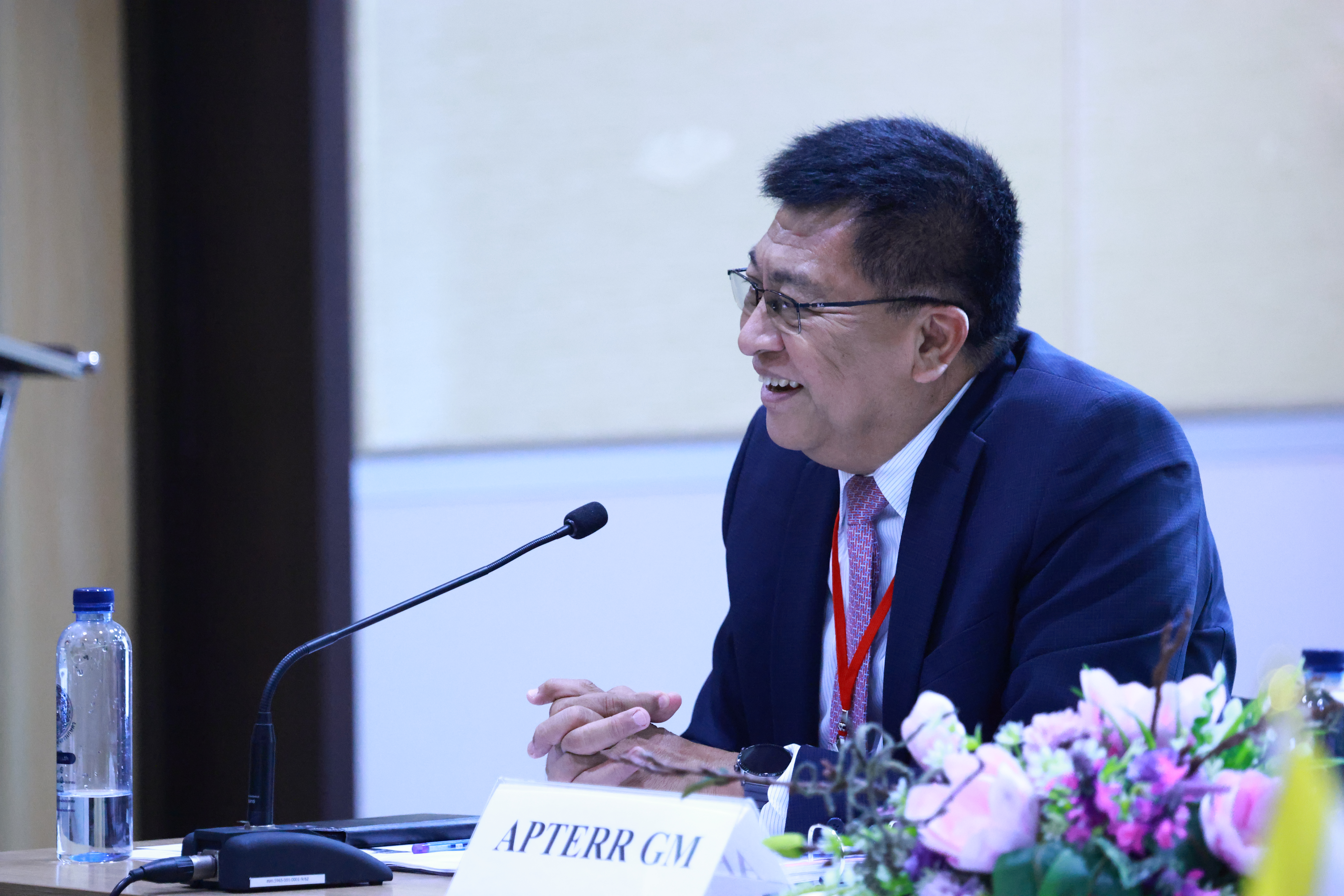
On 28-29 April 2025, The AFSIS Secretariat participated in a two-day workshop. This workshop aimed at strengthening the ASEAN Plus Three Emergency Rice Reserve (APTERR) Mechanism. Held at the Innovation Building, Office of Agricultural Economics, Bangkok, Thailand
the event gathered representatives from the APTERR member countries (except Viet Nam, which was unable to attend) as well as representatives from relevant organizations including the ASEAN Secretariat, the ASEAN Food Security Reserve Board (AFSRB) Secretariat, the ASEAN Food Security Information System (AFSIS) Secretariat, the Economic Research Institute for ASEAN and East Asia (ERIA) and the consultants from the Asian Development Bank (ADB).
The workshop, organized in collaboration with the Asian Development Bank (ADB), focused on reviewing and enhancing the effectiveness of APTERR in light of new challenges facing regional food security. Participants engaged in discussions on necessary improvements to the mechanism and how it can be adapted for future projects, particularly through collaboration with ongoing studies and initiatives led by ADB.
Building on the findings and recommendations of ADB’s systematic review of the APTERR mechanism, this working meeting provided critical inputs to serve as key guidance for the APTERR Secretariat in formulating a strategic action plan to boost the mechanism’s responsiveness and effectiveness.
In addition, participants discussed the potential integration of three initiatives including ADB’s ‘Sub-Regional Hub’, P.R. China’s ‘Public Warehouse’ and Japan’s ‘Rice Storage Hub (Tier 3 FLEX), into a new comprehensive initiative, along with the potential inclusion of ‘wheat stockpile’ under APTERR proposed by the Republic of Korea. The participants further shared valuable insights for conducting the APTERR Tabletop Exercise, aimed at enhancing the APTERR mechanism’s emergency response capabilities. The ERIA also provided an update on its study on the ‘Local Resource-Based Food Reserve (LRBFR).




The AFSIS Secretariat participated in the 10th International Conference on Agricultural Statistics (ICAS X), held from 8 to 10 July 2026 at the ICE Krakow Congress Centre in Krakow, Poland. Jointly organized by Statistics Poland, Eurostat, the United States Department of Agriculture (USDA), the World Bank Group, and the Food and Agriculture Organization of the United Nations (FAO).
.JPG)
On 24–25 June 2026, AFSIS Secretariat participated in the 46th Meeting of the ASEAN Food Security Reserve Board (AFSRB) via a virtual conference. The Meeting was jointly organized by the AFSRB Secretariat and the Department of Agriculture (DOA), Ministry of Agriculture, Livestock and Irrigation (MOALI) of the Republic of the Union of Myanmar, and was hosted in Nay Pyi Taw, Myanmar.

On 17–18 June 2026, the 24th AFSIS Focal Point Meeting was successfully convened via video conference, hosted by the Philippine Statistics Authority (PSA) in collaboration with the ASEAN Food Security Information System (AFSIS) Secretariat.
.jpg)
The ASEAN Food Security Information System (AFSIS) Secretariat, in collaboration with the Ministry of Agriculture, Forestry and Fisheries (MAFF) Japan, Japan Aerospace Exploration Agency (JAXA), Remote Sensing Technology Center of Japan (RESTEC), and Geo-Informatics and Space Technology Development Agency (GISTDA), conducted the 2nd Hands-on Training Courses for Agricultural Statisticians, the Final Workshop, and the 2nd Seminar for Executive Officials under the JAIF Project entitled “Improvement of Rice Paddy Area Statistics and Damage Assessment using Earth Observation Satellites for ASEAN” in Sriracha, Chonburi Province, and Bangkok, Thailand.

