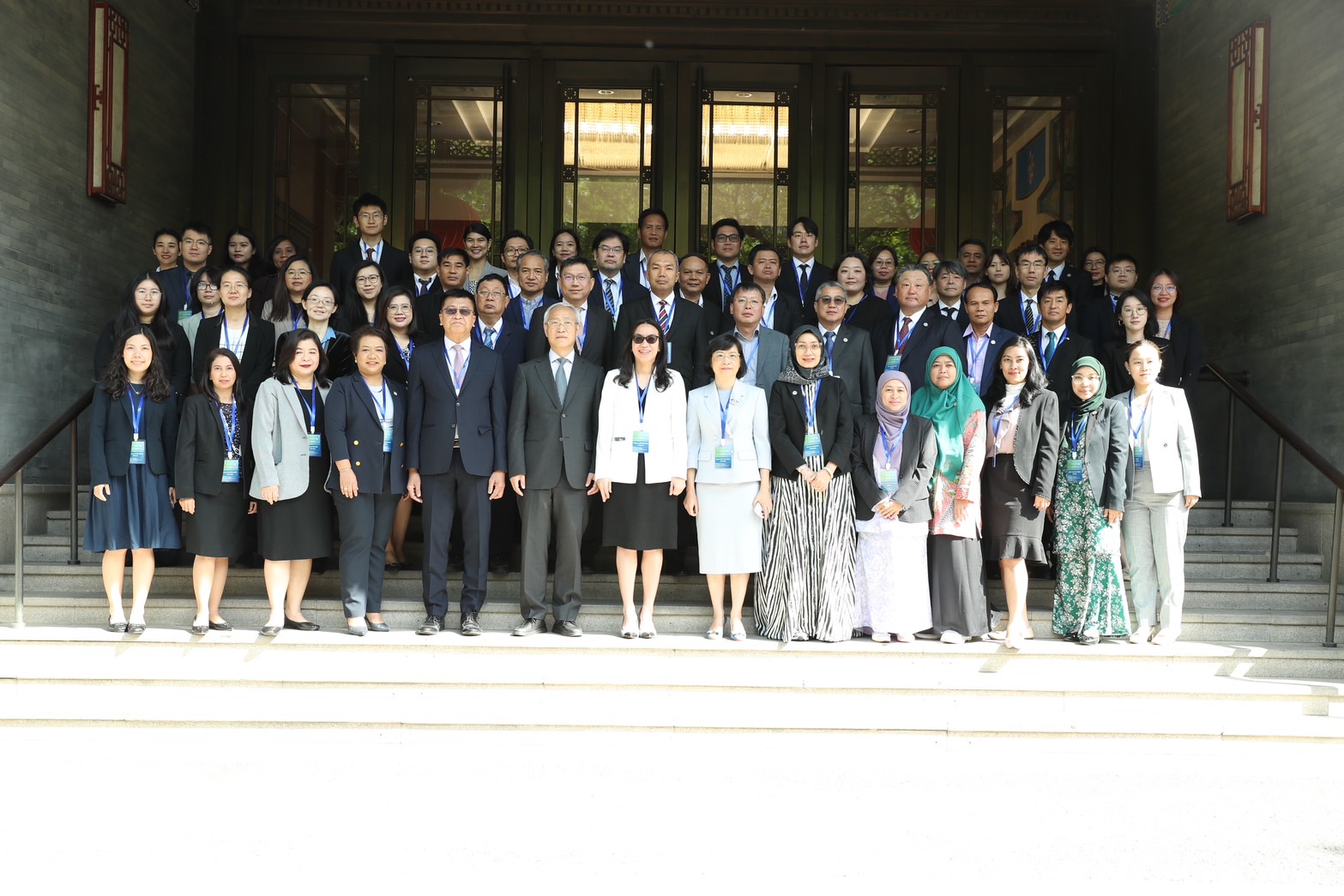
On 24-25 April 2024, the 12th Meeting of the ASEAN Plus Three Emergency Rice Reserve (APTERR) Council was conducted physically Beijing,People’s Republic of China.
The objectives of the meeting were to report the implementation of APTERR activities in 2023, discuss and propose the work plan and budget proposal for the fiscal year 2024, and the terminal report of the financial contribution to the APTERR Fund. Also, the Meeting was updated on the implementation under the Rice Discharge Mechanism, Program 3 (Tier 3 program) from the recipient countries such as Cambodia, Myanmar, Lao PDR, and Philippine


Attendees included representatives from the APTERR Council, ASEAN Plus Three countries (except the Philippines), the Asian Development Bank (ADB), the APTERR Secretariat, and the AFSIS Secretariat.
On this occasion, Dr. Sumanya Ngandee, AFSIS Manager, had an opportunity to present the AFSIS Implementation in 2023- the 1st quarter of 2024, the future work plan in 2024 and works related to APTERR. AFSIS provides data on the demand and supply of rice for annual reports and the analysis of monitoring and evaluating food emergency situations (Food Emergency Monitoring and Information: FEMI). This emphasizes the importance of AFSIS in the collection, analysis, and dissemination of ASEAN food security information.


Furthermore, this meeting provided all participants with the great opportunity to visit Xiaotangshan National Research and Demonstration Base for Precision Agriculture, Changping District, Beijing, People's Republic of China. The research center has developed technology for precision agriculture. and modern agriculture by using 3S technology, including GIS, GPS, and Remote Sensing, to effectively manage farmland and resources. These technologies lead to maximum efficiency at the right time to increase agricultural production, both quantity and quality, including helping reduce production costs, and safe for farmers and the environment.


The AFSIS Secretariat participated in the 10th International Conference on Agricultural Statistics (ICAS X), held from 8 to 10 July 2026 at the ICE Krakow Congress Centre in Krakow, Poland. Jointly organized by Statistics Poland, Eurostat, the United States Department of Agriculture (USDA), the World Bank Group, and the Food and Agriculture Organization of the United Nations (FAO).
.JPG)
On 24–25 June 2026, AFSIS Secretariat participated in the 46th Meeting of the ASEAN Food Security Reserve Board (AFSRB) via a virtual conference. The Meeting was jointly organized by the AFSRB Secretariat and the Department of Agriculture (DOA), Ministry of Agriculture, Livestock and Irrigation (MOALI) of the Republic of the Union of Myanmar, and was hosted in Nay Pyi Taw, Myanmar.

On 17–18 June 2026, the 24th AFSIS Focal Point Meeting was successfully convened via video conference, hosted by the Philippine Statistics Authority (PSA) in collaboration with the ASEAN Food Security Information System (AFSIS) Secretariat.
.jpg)
The ASEAN Food Security Information System (AFSIS) Secretariat, in collaboration with the Ministry of Agriculture, Forestry and Fisheries (MAFF) Japan, Japan Aerospace Exploration Agency (JAXA), Remote Sensing Technology Center of Japan (RESTEC), and Geo-Informatics and Space Technology Development Agency (GISTDA), conducted the 2nd Hands-on Training Courses for Agricultural Statisticians, the Final Workshop, and the 2nd Seminar for Executive Officials under the JAIF Project entitled “Improvement of Rice Paddy Area Statistics and Damage Assessment using Earth Observation Satellites for ASEAN” in Sriracha, Chonburi Province, and Bangkok, Thailand.

