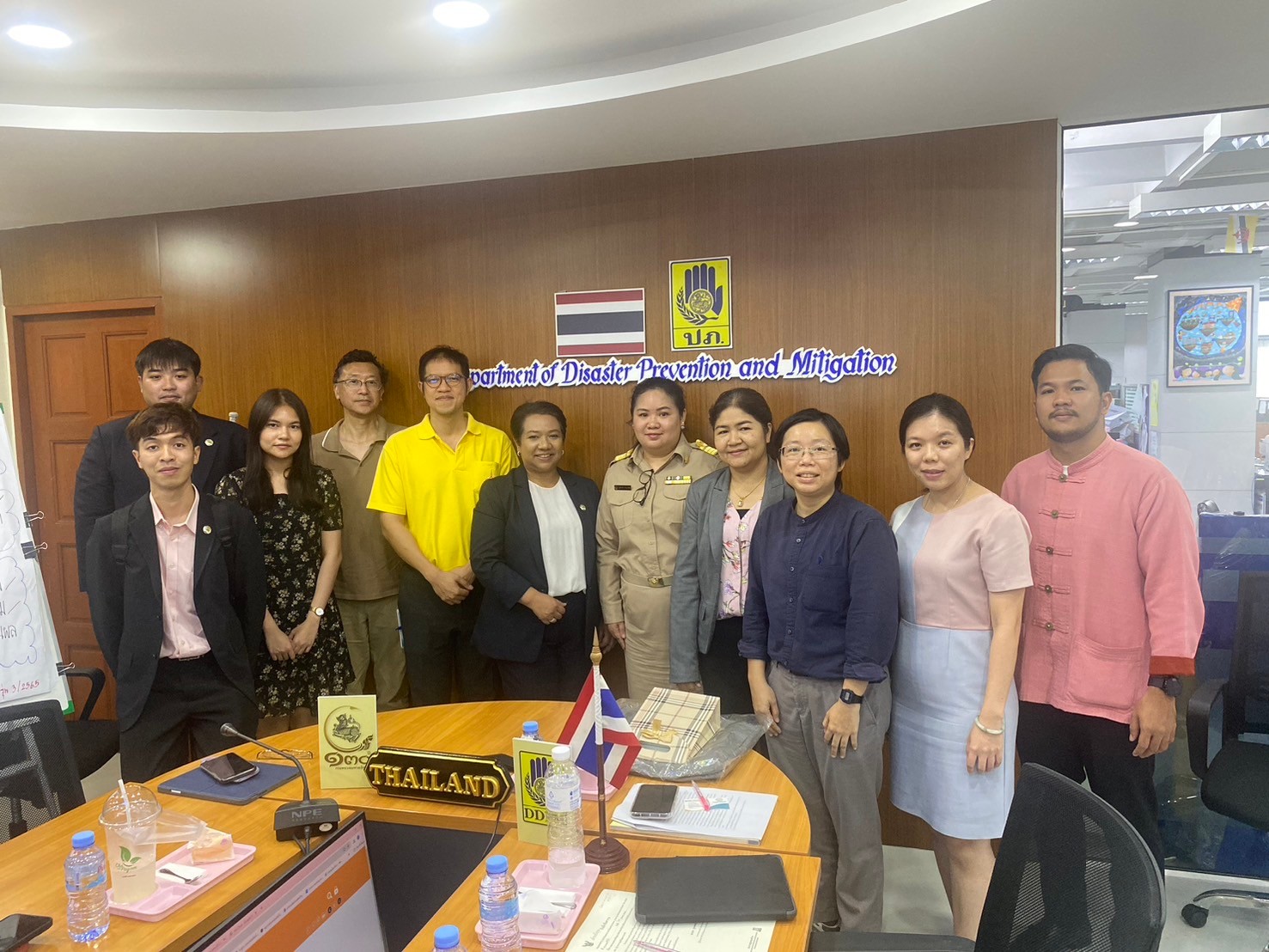
On 2 April 2024, the AFSIS Secretariat had an opportunity to visit the Department of Disaster Prevention and Mitigation (DDPM), Ministry of Interior, Thailand. The primary focus of the meeting was to gather insights on several key aspects related to emergency information-sharing mechanism of the DDPM.
The contents of the meeting which included procedures of criteria of data collection, situation monitoring, data analysis, report system and publication as well as cooperation with relevant international organizations.
During the Meeting, Dr. Sumanya Ngandee, an AFSIS Manager, introduced the overview of AFSIS’ s operations and informed the meeting about an emergency information-sharing activity which is one of the main activities under the Project for Strengthening ASEAN Food Security Information System (AFSIS) Function for Emergency (SAFER) or SAFER project.
Ms. Chatthip Chumphong, the Director of Academic Research and Development at the Research and International Cooperation Bureau of DDPM, along with Ms. Sujinphorn Panukan, the Director of the Disaster Data Center of DDPM and DDPM officers, provided an overview of DDPM's operations, the process of reporting disasters information in Thailand, mechanisms for updating the disaster database, and early warning mechanism during emergency situations.
The meeting was successful, with excellent cooperation from DDPM Officers. Dr. Sumaya Ngandee, AFSIS manager, expressed appreciation to the DDPM for sharing their valuable insights. AFSIS Secretariat to incorporate the knowledge gained from the meeting into the development of the emergency information-sharing mechanism of the SAFER project in providing timely information about ASEAN disasters and early which can be used for decision-making at a regional level.


The AFSIS Secretariat participated in the 10th International Conference on Agricultural Statistics (ICAS X), held from 8 to 10 July 2026 at the ICE Krakow Congress Centre in Krakow, Poland. Jointly organized by Statistics Poland, Eurostat, the United States Department of Agriculture (USDA), the World Bank Group, and the Food and Agriculture Organization of the United Nations (FAO).
.JPG)
On 24–25 June 2026, AFSIS Secretariat participated in the 46th Meeting of the ASEAN Food Security Reserve Board (AFSRB) via a virtual conference. The Meeting was jointly organized by the AFSRB Secretariat and the Department of Agriculture (DOA), Ministry of Agriculture, Livestock and Irrigation (MOALI) of the Republic of the Union of Myanmar, and was hosted in Nay Pyi Taw, Myanmar.

On 17–18 June 2026, the 24th AFSIS Focal Point Meeting was successfully convened via video conference, hosted by the Philippine Statistics Authority (PSA) in collaboration with the ASEAN Food Security Information System (AFSIS) Secretariat.
.jpg)
The ASEAN Food Security Information System (AFSIS) Secretariat, in collaboration with the Ministry of Agriculture, Forestry and Fisheries (MAFF) Japan, Japan Aerospace Exploration Agency (JAXA), Remote Sensing Technology Center of Japan (RESTEC), and Geo-Informatics and Space Technology Development Agency (GISTDA), conducted the 2nd Hands-on Training Courses for Agricultural Statisticians, the Final Workshop, and the 2nd Seminar for Executive Officials under the JAIF Project entitled “Improvement of Rice Paddy Area Statistics and Damage Assessment using Earth Observation Satellites for ASEAN” in Sriracha, Chonburi Province, and Bangkok, Thailand.

