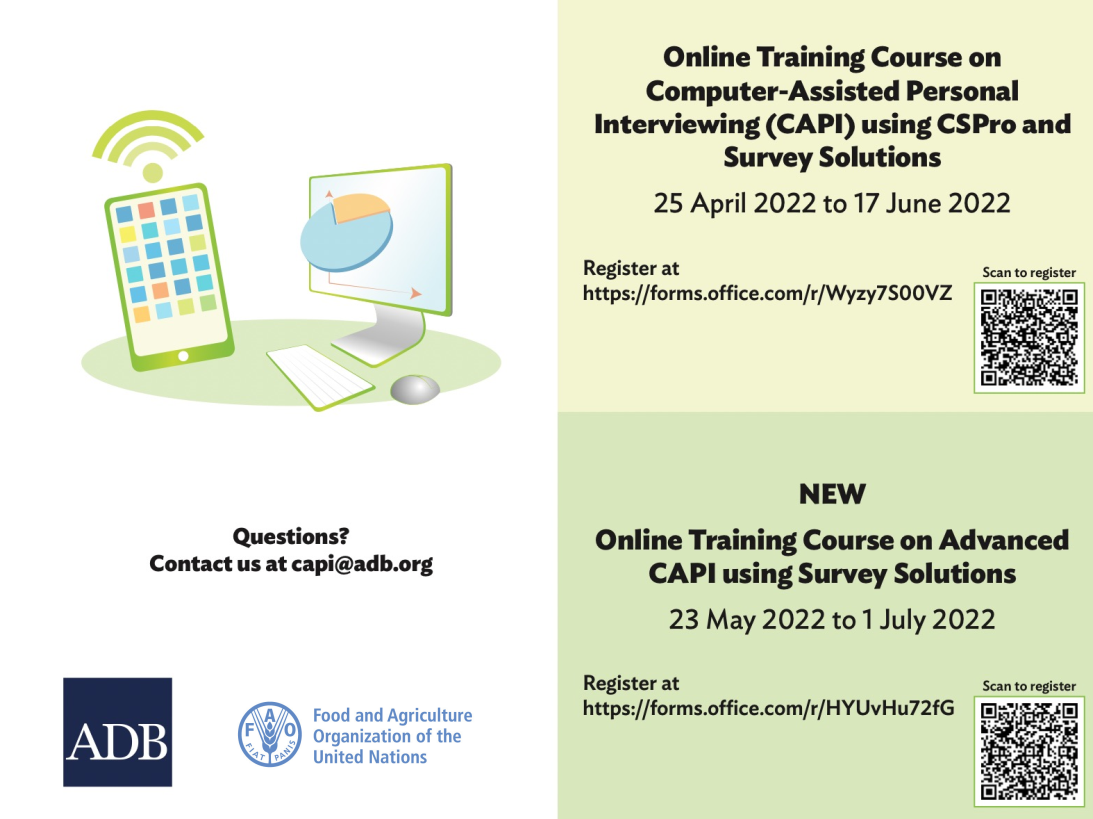
On 30 March 2022, the Asian Development Bank (ADB) and the FAO-Regional Office for Asia-Pacific have recently launched two free “Massive Open Online Courses (MOOCs) on Computer-Assisted Personal Interviewing (CAPI) using CSPro Android and Survey Solutions” for people who are interested in the basics of CAPI data collection and management, and also for those who would like to develop their own questionnaires and apply these skills to a wide variety of surveys.
Courses Background
The course was firstly launched in 2019 and it was very successful and led to the increase in demand from learners across the world. Therefore, in this year, ADB and FAO have decided to launch a fourth round of the two MOOCs free-of-charge.
Course benefits
The course will introduce learners to two free CAPI platforms being used by official data collection agencies across the world: (i) CSPro Android developed by the US Census Bureau, and (ii) Survey Solutions designed by the World Bank.
In This regard, we encourage staff in your organization who are interested in enhancing their skills in CAPI to register online at
-----> CAPI Online Course 4th Iteration Registration Form (office.com) by 29 April 2022.
Further advance course
Furthermore, a new online training course on Advanced CAPI using Survey Solutions will be launched on 23 May 2022. Note that only learners who have completed any of the previous iterations of the basic Survey Solutions course (including the current one) may take the advanced course. Interested participants may register online at
-----> Advanced Course on Survey Solutions Registration Form (office.com) by 13 May 2022.
The tools needed for the courses
The medium of instruction will be English. Those enrolling for the course are expected to have access to a computer, handheld device (Android based smartphone or tablet), and internet connectivity.
For the flyer and QR code, please click -----> New CAPI flyer 25March

The AFSIS Secretariat participated in the 10th International Conference on Agricultural Statistics (ICAS X), held from 8 to 10 July 2026 at the ICE Krakow Congress Centre in Krakow, Poland. Jointly organized by Statistics Poland, Eurostat, the United States Department of Agriculture (USDA), the World Bank Group, and the Food and Agriculture Organization of the United Nations (FAO).
.JPG)
On 24–25 June 2026, AFSIS Secretariat participated in the 46th Meeting of the ASEAN Food Security Reserve Board (AFSRB) via a virtual conference. The Meeting was jointly organized by the AFSRB Secretariat and the Department of Agriculture (DOA), Ministry of Agriculture, Livestock and Irrigation (MOALI) of the Republic of the Union of Myanmar, and was hosted in Nay Pyi Taw, Myanmar.

On 17–18 June 2026, the 24th AFSIS Focal Point Meeting was successfully convened via video conference, hosted by the Philippine Statistics Authority (PSA) in collaboration with the ASEAN Food Security Information System (AFSIS) Secretariat.
.jpg)
The ASEAN Food Security Information System (AFSIS) Secretariat, in collaboration with the Ministry of Agriculture, Forestry and Fisheries (MAFF) Japan, Japan Aerospace Exploration Agency (JAXA), Remote Sensing Technology Center of Japan (RESTEC), and Geo-Informatics and Space Technology Development Agency (GISTDA), conducted the 2nd Hands-on Training Courses for Agricultural Statisticians, the Final Workshop, and the 2nd Seminar for Executive Officials under the JAIF Project entitled “Improvement of Rice Paddy Area Statistics and Damage Assessment using Earth Observation Satellites for ASEAN” in Sriracha, Chonburi Province, and Bangkok, Thailand.

