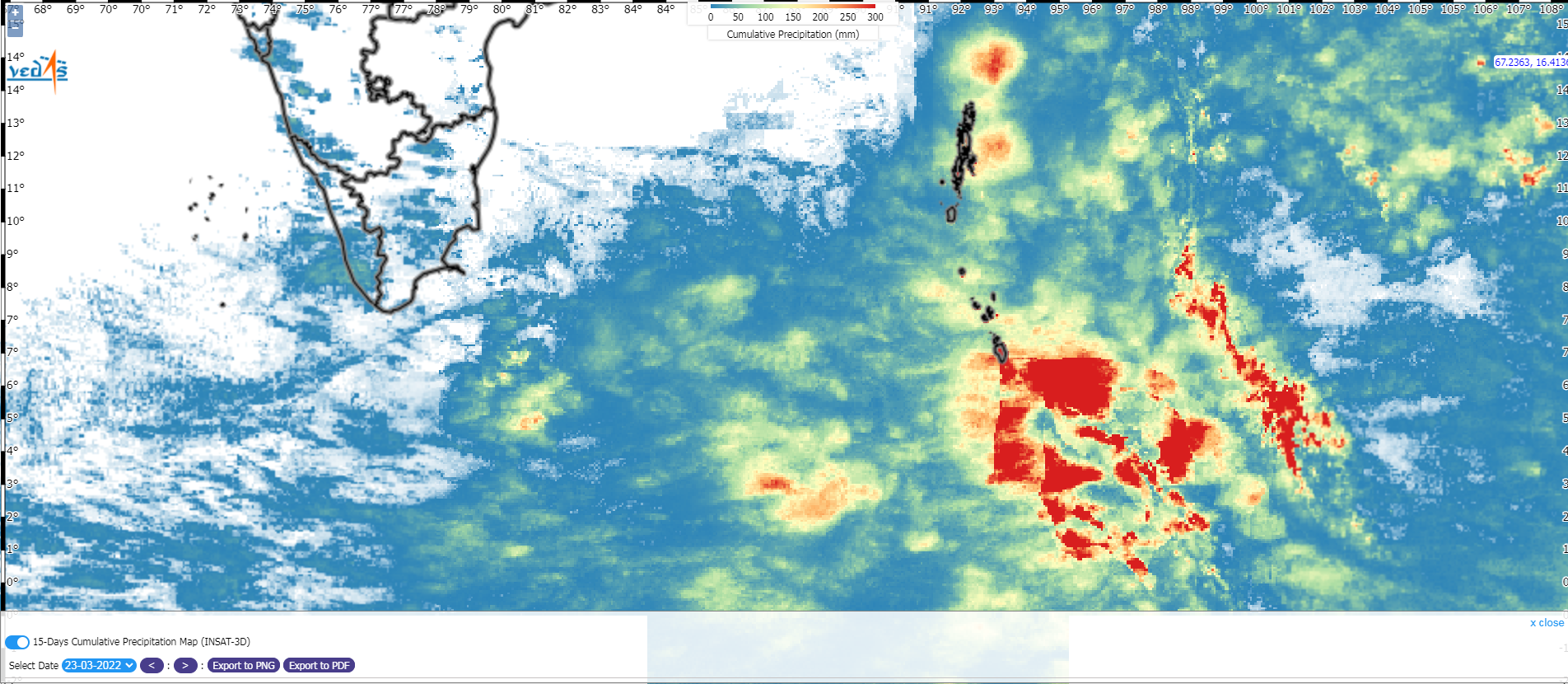
On 25 March 2022, the Indian Space Research Organisation (ISRO) has been successfully developed the web system called “VEDAS cloud system” to provide the wide-area precipitation data to AFSIS and the ASEAN Member Countries for Rice Growing Outlook report (RGO) activity.
This VEDAS cloud system is the following-up from the fruitful meeting between ASEAN Food Security Information System (AFSIS) together with Japan Aerospace Exploration Agency (JAXA) and ISRO on the 11th November 2021. The meeting confirmed the benefits of trilateral collaboration on the use of satellite-based information for RGO activities, and agreed to continue the collaboration to further with the objective to utilize the earth-observing satellite data for enhancing the food security system in ASEAN regions.
This is the one of the successful cooperation between AFSIS, JAXA, and ISRO since more trainings are currently planned for this near future.
For accessing the wide-area precipitation data, please kindly visit: https://vedas.sac.gov.in/AFSIS
.JPG)
From 15–16 September 2026, the AFSIS Secretariat, in collaboration with the Japan Aerospace Exploration Agency (JAXA), Remote Sensing Technology Center of Japan (RESTEC), Ministry of Agriculture, Forestry and Fisheries (MAFF) Japan, and the Philippine Statistics Authority (PSA), conducted the “Workshop on Promote rice planted area and production estimation using space-based technologies in the Philippines” at Park Inn by Radisson North EDSA, Quezon City, Manila, the Philippines.

On 19 August 2026, the AFSIS Secretariat participated in the Special Senior Officials Meeting of the 25th Meeting of the ASEAN Ministers on Agriculture and Forestry Plus Three (Special SOM-25th AMAF Plus Three), hosted by the Philippines via video conference. The Meeting was attended by Senior Officials from ASEAN Member States, the Plus Three countries, and the ASEAN Secretariat. The AFSIS Secretariat was represented by Dr. Sumanya Ngandee, AFSIS Manager.

On 29 July 2026, the APEC Policy Partnership on Food Security (PPFS) successfully convened the APEC PPFS Webinar on Strategic Cooperation for Strengthening Food System Resilience via a virtual platform. The webinar was organized by the Ministry of Agriculture, Food and Rural Affairs (MAFRA) of the Republic of Korea as a self-funded PPFS project to promote strategic cooperation and knowledge exchange on strengthening food system resilience across APEC member economies.

The AFSIS Secretariat participated in the 10th International Conference on Agricultural Statistics (ICAS X), held from 8 to 10 July 2026 at the ICE Krakow Congress Centre in Krakow, Poland. Jointly organized by Statistics Poland, Eurostat, the United States Department of Agriculture (USDA), the World Bank Group, and the Food and Agriculture Organization of the United Nations (FAO).

