.png)
Report and Disseminate the Information Regarding
the Serious Disaster
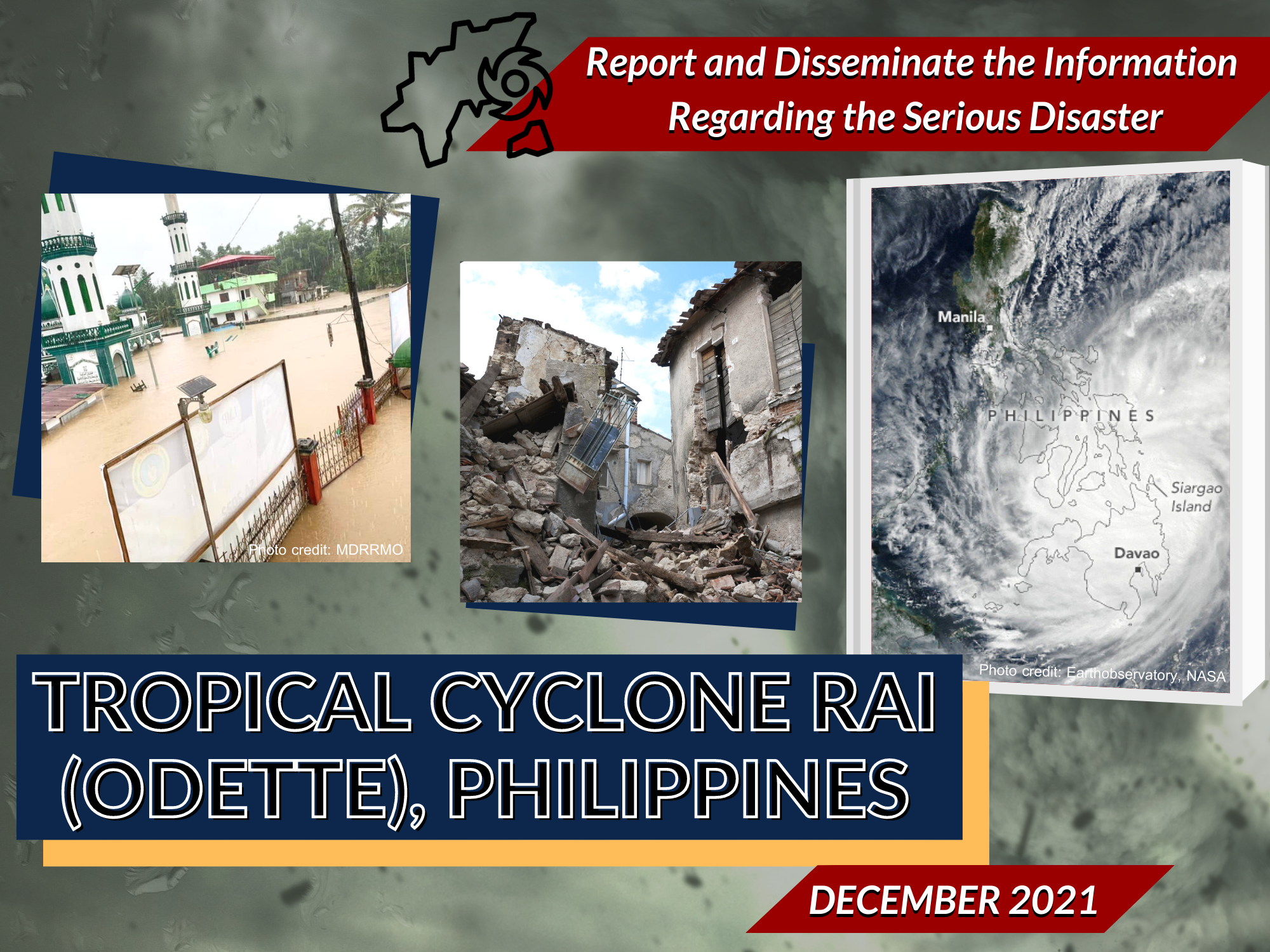
Typhoon Rai (Odette) in Philippines
December 2021
Source: The Philippines’ National Disaster Risk Reduction and Management Council (NDRRMC); Philippine Statistics Authority (PSA), Republic of the Philippines; Department of Agriculture, Republic of the Philippines
According to the National Disaster Risk Reduction and Management Council (NDRRMC), the areas most affected by Typhoon Odette were Northeastern Mindanao, Western Visayas, Central Visayas, and Palawan. Officials in the provinces of Cebu, Guimaras and Bohol-municipality of Jose Panganiban, Camarines Norte, along with 12 cities and municipalities in Caraga region also declared a state of calamity. Moreover, the damaged area covers in the regions of Calabarzon, Bicol, Western Visayas, central Visayas, Eastern Visayas, Soccsksargen, Davao, and Caraga. These include Mimaropa (Region 4B), Western Visayas (Region 6), Central Visayas (Region 7), Eastern Visayas (Region 8), Northern Mindanao (Region 10), Davao (Region 11), Caraga (Region 13), and Bangsamoro Autonomous Region in Muslim Mindanao (BARMM). In result, the storm destroyed various government facilities, flood control projects, roads, bridges and other infrastructures which amounted to PHP 225,170,000 as well as various agricultural products worth PHP 118,284,774.
As of the latest report in 2021, there are reportedly 5,391 hectares of crops, as well as 15 livestock and poultry facilities, damaged due to Typhoon Odette. Since the agricultural damage was valued at PHP 118,284,774, it means a total of 12,750 farmers and fishers have been affected, with volume of production loss at 19,640 metric tons, spanning 23,198 hectares of agricultural areas and affected commodities include rice, corn, fisheries, and high value crops. Farming and fishing losses caused by Typhoon Odette (Rai) have so far reached PHP 333.4 million, according to the Department of Agriculture of the Philippines on Monday, December 20th.
Regarding to the countermeasures or policies to encounter this situation, NDRRMC claimed that, unlike previous "devastating" typhoons, local government and the public preparedness were more focused this time by citing the over 400,000 potential victims of Odette who were pre-emptively evacuated. Meanwhile, 442,424 people were displaced, while 385,086 individuals were pre-emptively evacuated. The report also added that 2,435 evacuation centers were opened for the victims. For the aiding from the government, a total of PHP 14 million worth of assistance has already been provided by the Department of Social Welfare and Development (DSWD) of the Philippines to the affected population. Also, a standby resource of PHP 944 million including 374,000 food packs and non-food items are being prepared for deployment.
In terms of the international supports, the government of China is ready to offer assistance to the victims of Typhoon Odette as the Chinese embassy in Manila have mentioned on Friday. Additionally, on Twitter, the embassy also expressed sadness over the devastation wrought by the typhoon in the Visayas and Mindanao. Furthermore, the United Nations (UN) resident coordinator in the Philippines said that the body is coordinating with the UN’s humanitarian country team, which is composed of relevant international and national non-government organizations (NGOs), as well as the private sector.
Download word file click here --> Typhoon Rai (Odette) in Philippines

The AFSIS Secretariat participated in the 10th International Conference on Agricultural Statistics (ICAS X), held from 8 to 10 July 2026 at the ICE Krakow Congress Centre in Krakow, Poland. Jointly organized by Statistics Poland, Eurostat, the United States Department of Agriculture (USDA), the World Bank Group, and the Food and Agriculture Organization of the United Nations (FAO).
.JPG)
On 24–25 June 2026, AFSIS Secretariat participated in the 46th Meeting of the ASEAN Food Security Reserve Board (AFSRB) via a virtual conference. The Meeting was jointly organized by the AFSRB Secretariat and the Department of Agriculture (DOA), Ministry of Agriculture, Livestock and Irrigation (MOALI) of the Republic of the Union of Myanmar, and was hosted in Nay Pyi Taw, Myanmar.

On 17–18 June 2026, the 24th AFSIS Focal Point Meeting was successfully convened via video conference, hosted by the Philippine Statistics Authority (PSA) in collaboration with the ASEAN Food Security Information System (AFSIS) Secretariat.
.jpg)
The ASEAN Food Security Information System (AFSIS) Secretariat, in collaboration with the Ministry of Agriculture, Forestry and Fisheries (MAFF) Japan, Japan Aerospace Exploration Agency (JAXA), Remote Sensing Technology Center of Japan (RESTEC), and Geo-Informatics and Space Technology Development Agency (GISTDA), conducted the 2nd Hands-on Training Courses for Agricultural Statisticians, the Final Workshop, and the 2nd Seminar for Executive Officials under the JAIF Project entitled “Improvement of Rice Paddy Area Statistics and Damage Assessment using Earth Observation Satellites for ASEAN” in Sriracha, Chonburi Province, and Bangkok, Thailand.

