.png)
Report and Disseminate the Information Regarding
the Serious Disaster
Heavy rains flood in Indonesia
February 2021
Source: Indonesia’s Badan Nasional Penanggulangan Bencana (BNPB) and Ministry of Agriculture Indonesia
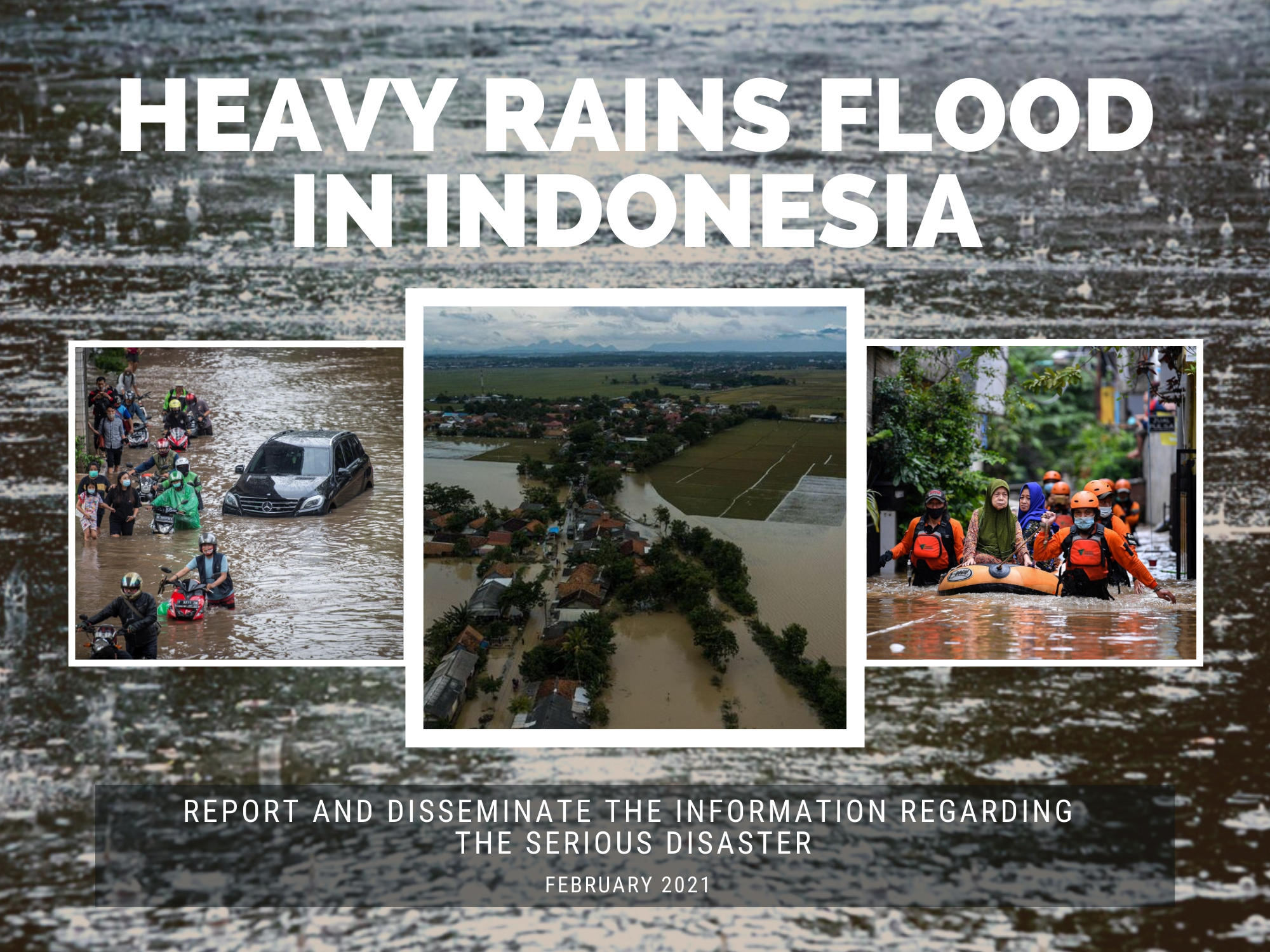
On February 19, 2021,heavy rains in Indonesia caused the breaking of embankments and the overflowing of some rivers, which led to inundation and flooding in Central Jakarta, west Jakarta, East Jakarta, South Jakarta, Bekasi City, Bekasi Regency, Depok City, Bogor Regency, Tangerang Regency, South Tangerang City, Tangerang City, Bogor City, and Karawang Regency. 5 people dead, 46,772 families or 176,157 people were affected by the flood and 7,040 families or 31,396 people have been evacuated.
In addition, according to the report from Indonesia’s Badan Nasional Penanggulangan Bencana (BNPB), high intensity rain on 23 February 2021 caused flooding in Semarang City. They reported that as many as 18,118 families or 90,590 people by the flood and 9,169 houses have been submerged to flood water levels approximately 10 -75 centimeters.
Regarding theimpacts of heavy rain and flooding in all regions of Indonesia during January – February 2021 on agricultural sector are as follows.
1) 35,976 hectares out of 184,344 hectares of affected rice planted areas from the flooding were damaged.
2) 200 hectares out of 870 hectares of affected maize planted areas from the flooding were damaged.
3) 21.5 hectares out of 33 hectares of affected soybeans planted areas from the flooding were damaged.
4) 0.9 hectares out of 1.9 hectares of affected cassava planted areas from the flooding were damaged.
Note: Plants are called damage if their production is less than 11% of normal production.
In this regard, BNPB is supporting the emergency management for flood and its surroundings. The head of BNPB also visited flood management in Karawang and provided 35.5K USD in aid.
Download word file click here --> Heavy rains flood in Indonesia

On 19 August 2026, the AFSIS Secretariat participated in the Special Senior Officials Meeting of the 25th Meeting of the ASEAN Ministers on Agriculture and Forestry Plus Three (Special SOM-25th AMAF Plus Three), hosted by the Philippines via video conference. The Meeting was attended by Senior Officials from ASEAN Member States, the Plus Three countries, and the ASEAN Secretariat. The AFSIS Secretariat was represented by Dr. Sumanya Ngandee, AFSIS Manager.

On 29 July 2026, the APEC Policy Partnership on Food Security (PPFS) successfully convened the APEC PPFS Webinar on Strategic Cooperation for Strengthening Food System Resilience via a virtual platform. The webinar was organized by the Ministry of Agriculture, Food and Rural Affairs (MAFRA) of the Republic of Korea as a self-funded PPFS project to promote strategic cooperation and knowledge exchange on strengthening food system resilience across APEC member economies.

The AFSIS Secretariat participated in the 10th International Conference on Agricultural Statistics (ICAS X), held from 8 to 10 July 2026 at the ICE Krakow Congress Centre in Krakow, Poland. Jointly organized by Statistics Poland, Eurostat, the United States Department of Agriculture (USDA), the World Bank Group, and the Food and Agriculture Organization of the United Nations (FAO).
.JPG)
On 24–25 June 2026, AFSIS Secretariat participated in the 46th Meeting of the ASEAN Food Security Reserve Board (AFSRB) via a virtual conference. The Meeting was jointly organized by the AFSRB Secretariat and the Department of Agriculture (DOA), Ministry of Agriculture, Livestock and Irrigation (MOALI) of the Republic of the Union of Myanmar, and was hosted in Nay Pyi Taw, Myanmar.

