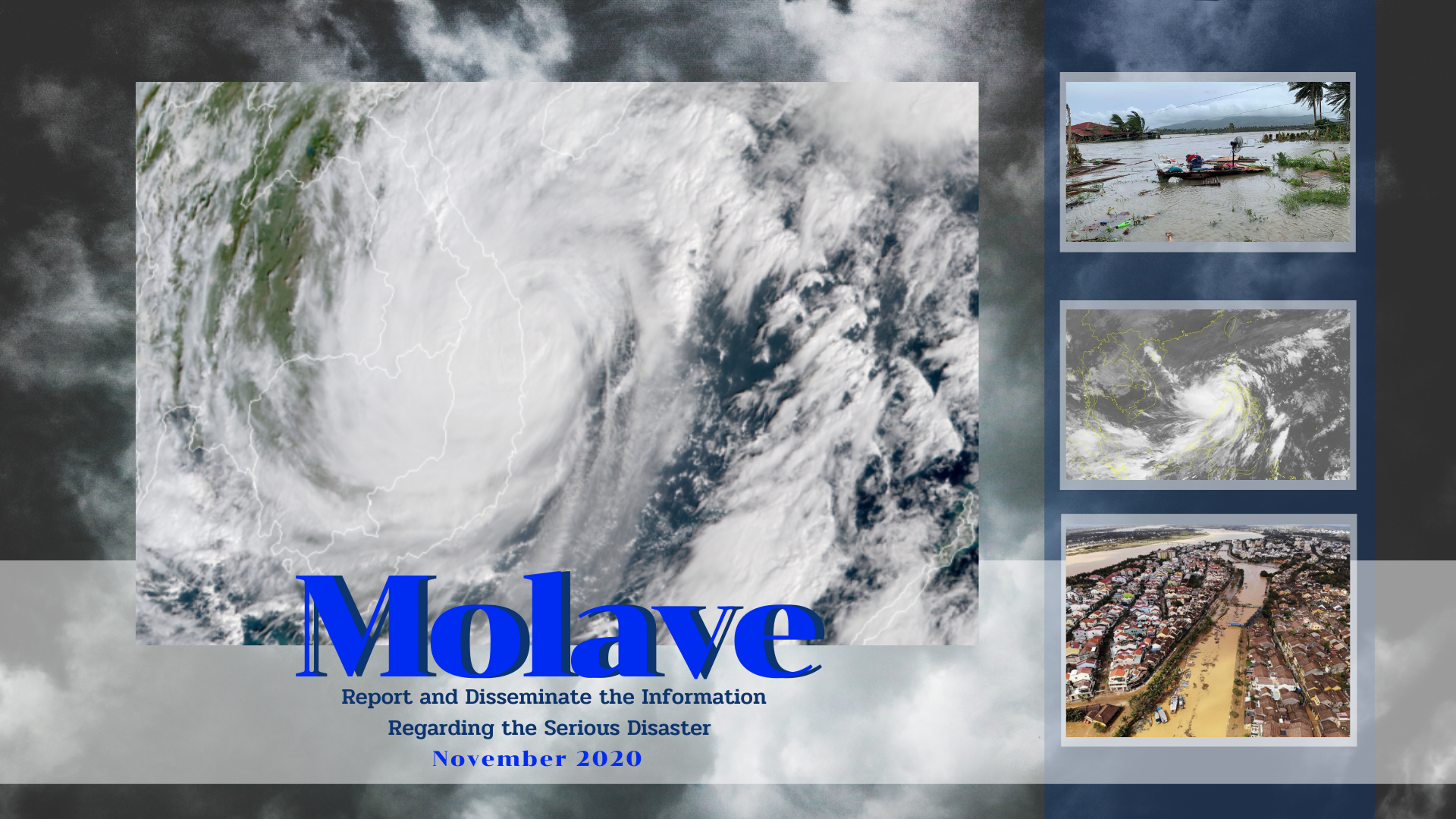
Report and Disseminate the Information Regarding
the Serious Disaster
Typhoon Molave
November 2020
Source: Center for Informatics and Statistics, Ministry of Agriculture and Rural development, Vietnam
Molave, the 9th typhoon in Vietnam in 2020, is one of the two strongest typhoons in Vietnam during the last 20 years. The typhoon Molave caused heavy rain, unprecedented prolonged inundation and severe landslides. This mainly affected provinces in Central Vietnam such as Phú Yên, Quảng Nam, Quảng Ngãi, Thừa Thiên - Huế, Đà Nẵng. The expected damages are substantial with 40 people dead, 43 people missing and 140 people injured, and a number of residential areas were isolated by flood and landslides.
With regard to the information of Central Committee for Natural Disaster Prevention and Control, the typhoon damaged the 28,000 hectares of rice and other crops. As a result, the harvested areas, yield and production of rice and other crops in Central Vietnam provinces are expected to decrease in 2020 due to the impact of Typhoon Molave. Apart from the typhoon, the planted area and production of crops in Vietnam were also impacted by irregular and harsh weather conditions.
However, the Vietnamese government actively dealt with Typhoon Molave by evacuating people, canceling flights, and closing schools and beaches before the storm occurred. Additionally, the government also supported people to cope with storms by providing food, water, and essential necessities for people to avoid storms and providing relief for goods, medicine, and disease prevention after storms as well as organizing to search and rescue missing and lost persons. In addition, international organizations namely ASEAN, EU, UNICEF, the United States, Australia, Japan, Korea, and Taiwan are also providing support in terms of financial relief to Vietnam.
Word File : AFSIS Molave in Vietnam

The AFSIS Secretariat participated in the 10th International Conference on Agricultural Statistics (ICAS X), held from 8 to 10 July 2026 at the ICE Krakow Congress Centre in Krakow, Poland. Jointly organized by Statistics Poland, Eurostat, the United States Department of Agriculture (USDA), the World Bank Group, and the Food and Agriculture Organization of the United Nations (FAO).
.JPG)
On 24–25 June 2026, AFSIS Secretariat participated in the 46th Meeting of the ASEAN Food Security Reserve Board (AFSRB) via a virtual conference. The Meeting was jointly organized by the AFSRB Secretariat and the Department of Agriculture (DOA), Ministry of Agriculture, Livestock and Irrigation (MOALI) of the Republic of the Union of Myanmar, and was hosted in Nay Pyi Taw, Myanmar.

On 17–18 June 2026, the 24th AFSIS Focal Point Meeting was successfully convened via video conference, hosted by the Philippine Statistics Authority (PSA) in collaboration with the ASEAN Food Security Information System (AFSIS) Secretariat.
.jpg)
The ASEAN Food Security Information System (AFSIS) Secretariat, in collaboration with the Ministry of Agriculture, Forestry and Fisheries (MAFF) Japan, Japan Aerospace Exploration Agency (JAXA), Remote Sensing Technology Center of Japan (RESTEC), and Geo-Informatics and Space Technology Development Agency (GISTDA), conducted the 2nd Hands-on Training Courses for Agricultural Statisticians, the Final Workshop, and the 2nd Seminar for Executive Officials under the JAIF Project entitled “Improvement of Rice Paddy Area Statistics and Damage Assessment using Earth Observation Satellites for ASEAN” in Sriracha, Chonburi Province, and Bangkok, Thailand.

