
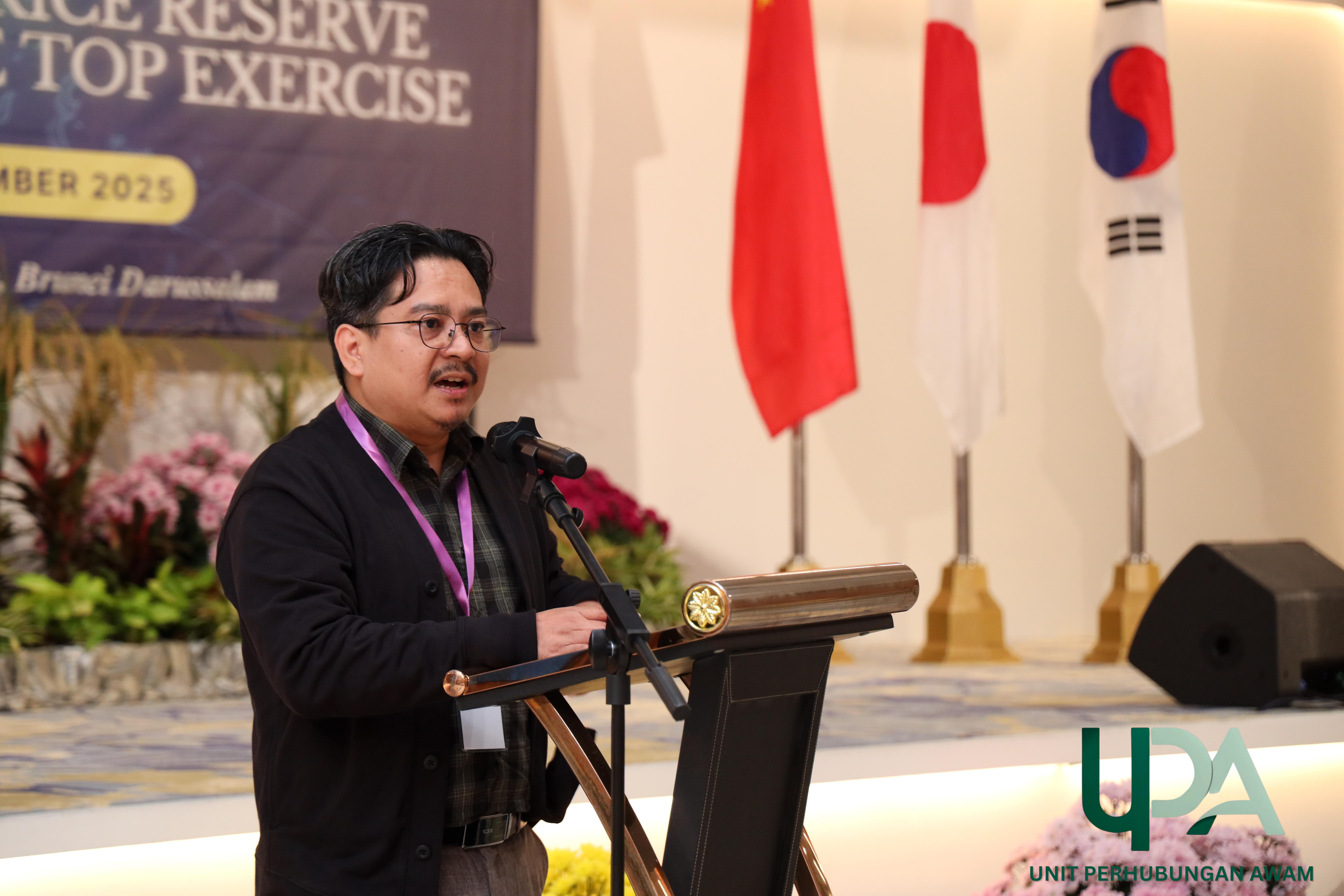
On 3–4 December 2025, the ASEAN Food Security Information System (AFSIS) Secretariat participated in the ASEAN Plus Three Emergency Rice Reserve (APTERR) Table Top Exercise (TTX) held in Bandar Seri Begawan, Brunei Darussalam.
The meeting was hosted by the Ministry of Foreign Affairs, the Ministry of Primary Resources and Tourism of Brunei Darussalam, and the APTERR Secretariat. The meeting was attended by representatives from ASEAN+3 member countries, the APTERR Council, as well as observers from the Asian Development Bank (ADB), International Rice Research Institute (IRRI), and ASEAN Secretariat.
The main objective of the TTX was to assess the overall readiness and effectiveness of the APTERR mechanism in responding to food crises across all three (3) Tiers. The exercise aimed to strengthen coordination among relevant agencies, clarify crisis activation procedures, and enhance understanding of emergency response mechanisms. It also sought to identify gaps in operational plans, promote the use of digital tools for early warning and information sharing, and improve efficiency, coordination, and the overall responsiveness of APTERR during emergencies.
On this occasion, Dr. Sumanya Ngandee, AFSIS Manager, delivered a presentation titled “AFSIS: Towards Credible, Reliable, Up-to-date, and Early Warning Food Security Information.” She also participated in group discussions focused on strengthening APTERR operations and advancing collaboration between AFSIS and APTERR under the FEMI Project.
The workshop also provided an opportunity for ASEAN+3 representatives to exchange views on the implementation of APTERR operations, including progress and future directions under the APTERR Tier 1 mechanism.
The event concluded on a positive note, with all member states expressing strong commitment to continued cooperation and enhanced collaboration between AFSIS and APTERR moving forward.



The AFSIS Secretariat participated in the 10th International Conference on Agricultural Statistics (ICAS X), held from 8 to 10 July 2026 at the ICE Krakow Congress Centre in Krakow, Poland. Jointly organized by Statistics Poland, Eurostat, the United States Department of Agriculture (USDA), the World Bank Group, and the Food and Agriculture Organization of the United Nations (FAO).
.JPG)
On 24–25 June 2026, AFSIS Secretariat participated in the 46th Meeting of the ASEAN Food Security Reserve Board (AFSRB) via a virtual conference. The Meeting was jointly organized by the AFSRB Secretariat and the Department of Agriculture (DOA), Ministry of Agriculture, Livestock and Irrigation (MOALI) of the Republic of the Union of Myanmar, and was hosted in Nay Pyi Taw, Myanmar.

On 17–18 June 2026, the 24th AFSIS Focal Point Meeting was successfully convened via video conference, hosted by the Philippine Statistics Authority (PSA) in collaboration with the ASEAN Food Security Information System (AFSIS) Secretariat.
.jpg)
The ASEAN Food Security Information System (AFSIS) Secretariat, in collaboration with the Ministry of Agriculture, Forestry and Fisheries (MAFF) Japan, Japan Aerospace Exploration Agency (JAXA), Remote Sensing Technology Center of Japan (RESTEC), and Geo-Informatics and Space Technology Development Agency (GISTDA), conducted the 2nd Hands-on Training Courses for Agricultural Statisticians, the Final Workshop, and the 2nd Seminar for Executive Officials under the JAIF Project entitled “Improvement of Rice Paddy Area Statistics and Damage Assessment using Earth Observation Satellites for ASEAN” in Sriracha, Chonburi Province, and Bangkok, Thailand.

