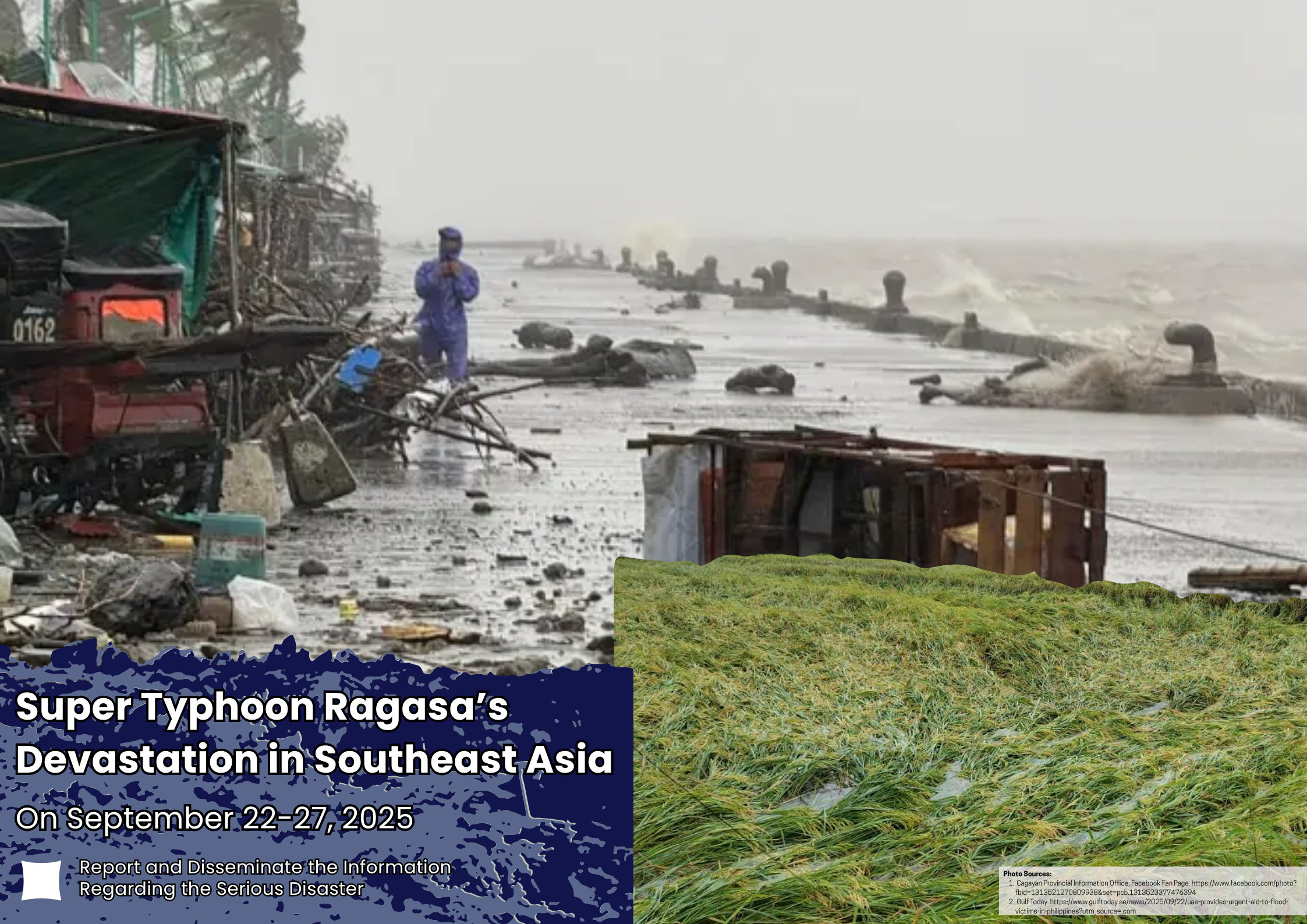
Super Typhoon Ragasa’s Devastation in Southeast Asia
Tropical Cyclone Ragasa on September 22–27, 2025
On September 22, tropical cyclone Ragasa, which was locally named “Nando”, developed and intensified into a super typhoon as it moved toward the Babuyan Islands in the Philippines. The cyclone reached maximum sustained winds of 205 km/h, with gusts up to 250 km/h. The agency revealed that the cyclone passed over the Babuyan Islands, bringing heavy rainfall to the surrounding regions. On September 23, the cyclone moved across the Philippines, leaving widespread hazards such as destructive winds, particularly strong along coastal, upland, and mountainous areas, intended rainfall exceeding 200 mm in some areas, which caused severe flooding and landslides, as well as coastal inundation due to storm surges with peak heights over 3 meters. By September 25, the cyclone moved westward and gradually weakened as it entered Vietnam. On September 26, it further weakened into a tropical depression and later into a low-pressure area over northern Vietnam. The country experienced strong winds ranging from level 6–7, increasing to level 8–9 near the center of the cyclone with gusts up to level 10, while rainfall in some areas exceeded 400 mm.
Additionally, between September 24 and 27, Lao PDR was also affected by the cyclone, experiencing heavy to severe rainfall across northern, central, and southern regions. The influences of the tropical cyclone Ragasa extended to Thailand between September 24 and 26, resulting in increased rainfall over the northern, northeastern, central, and eastern regions, compounded by the prevailing southwest monsoon over the Andaman Sea and the Gulf of Thailand. The accumulated rainfall in Thailand caused flash floods and river overflows, particularly in foothill areas, lowlands, and flood-prone zones.
Damage and losses
Impact on the affected area Tropical cyclone Ragasa caused widespread impacts across several ASEAN countries. In the Philippines, it resulted in severe flooding and landslides, six reported deaths, and the displacement of over 190,000 people across multiple regions. Extensive damage was recorded in agriculture, with more than 16,000 hectares of farmland affected and losses amounting to hundreds of millions of pesos, along with widespread power outages, infrastructure damage, and disrupted communication lines. In Vietnam, the cyclone brought heavy rainfall, strong winds, and high waves, particularly affecting coastal and northern provinces. Authorities reported significant risks of flooding, landslides, and damage to vessels and coastal infrastructure. In Lao PDR, the cyclone produced heavy to very heavy rainfall nationwide, raising the risk of flash floods and landslides, particularly in the central and southern provinces. Meanwhile, in Thailand, the cyclone intensified the southwest monsoon, resulting in heavy rainfall, flash floods, and rising water levels in northern and northeastern regions. Flooding was reported in at least 16 provinces, while coastal areas experienced high waves of up to three meters in the Andaman Sea and upper Gulf of Thailand. Overall, the cyclone brought severe hydrometeorological impacts across the region, with extensive disruptions to livelihoods, agriculture, and infrastructure.
Agricultural devastation
Agricultural land:
Affected crops:
Government responses and countermeasures
In Lao PDR, no official reports on government measures have been received.
In the Philippines, thousands of residents sought shelter in evacuation centers due to flooding and strong winds. Local governments distributed food packs, hygiene kits, and relief items. National agencies were conducting damage and needs assessments to support recovery, housing repair, and agricultural rehabilitation. The National Food Authority has 2.4 million rice bags on standby, and the Emirates Red Crescent provided humanitarian aid to over 18,000 affected people in Mindanao.
In Thailand, all regions reported rainfall impacts, but no official information on government response has been released.
In Vietnam, the government issued multiple directives emphasizing maximum readiness and proactive measures across provinces from Quang Ngai to Ha Tinh. Ministries coordinated actions to protect lives, property, and infrastructure, ensure safety of vessels, and secure dikes, dams, and essential facilities. Over 54,000 vessels and 215,700 workers were alerted and guided to safe areas. Authorities accelerated crop harvesting and deployed pumping systems to safeguard rice production.
Sources:
Download PDF file click here: Super Typhoon Ragasa’s Devastation in Southeast Asia

The AFSIS Secretariat participated in the 10th International Conference on Agricultural Statistics (ICAS X), held from 8 to 10 July 2026 at the ICE Krakow Congress Centre in Krakow, Poland. Jointly organized by Statistics Poland, Eurostat, the United States Department of Agriculture (USDA), the World Bank Group, and the Food and Agriculture Organization of the United Nations (FAO).
.JPG)
On 24–25 June 2026, AFSIS Secretariat participated in the 46th Meeting of the ASEAN Food Security Reserve Board (AFSRB) via a virtual conference. The Meeting was jointly organized by the AFSRB Secretariat and the Department of Agriculture (DOA), Ministry of Agriculture, Livestock and Irrigation (MOALI) of the Republic of the Union of Myanmar, and was hosted in Nay Pyi Taw, Myanmar.

On 17–18 June 2026, the 24th AFSIS Focal Point Meeting was successfully convened via video conference, hosted by the Philippine Statistics Authority (PSA) in collaboration with the ASEAN Food Security Information System (AFSIS) Secretariat.
.jpg)
The ASEAN Food Security Information System (AFSIS) Secretariat, in collaboration with the Ministry of Agriculture, Forestry and Fisheries (MAFF) Japan, Japan Aerospace Exploration Agency (JAXA), Remote Sensing Technology Center of Japan (RESTEC), and Geo-Informatics and Space Technology Development Agency (GISTDA), conducted the 2nd Hands-on Training Courses for Agricultural Statisticians, the Final Workshop, and the 2nd Seminar for Executive Officials under the JAIF Project entitled “Improvement of Rice Paddy Area Statistics and Damage Assessment using Earth Observation Satellites for ASEAN” in Sriracha, Chonburi Province, and Bangkok, Thailand.

