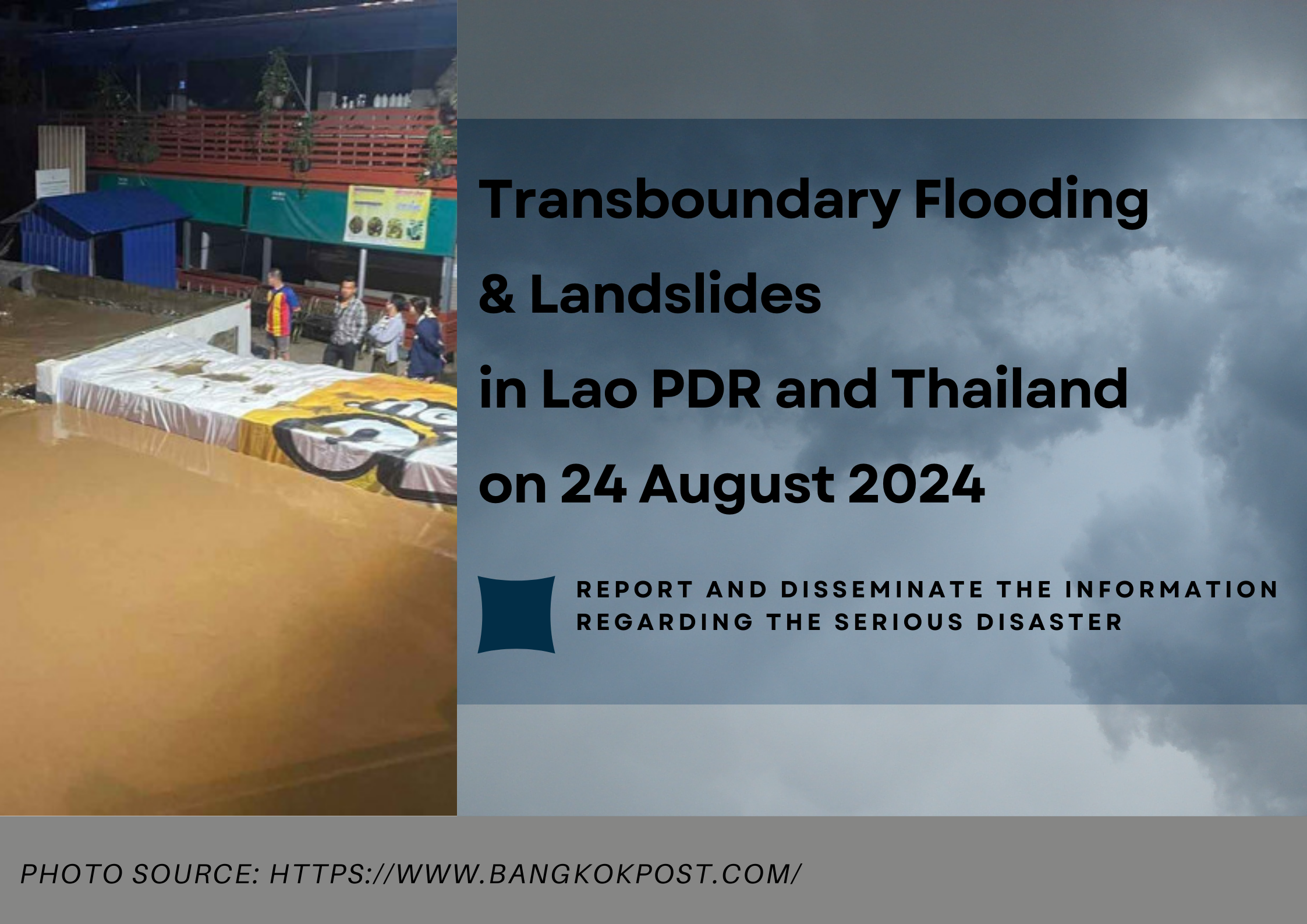

Transboundary Flooding & Landslides in Lao PDR and Thailand
On 24 August 2024
Heavy Rainfall Triggers Severe Flooding in Lao PDR and Thailand
On 23 August 2024, the National Disaster Management Office (NDMO) of Lao PDR reported severe flooding across six districts in Xayaboury Province, caused by continuous heavy rainfall since 20 August. The floods have led to extensive damage, affecting large swathes of agricultural land and posing a significant threat to the livelihoods of local farmers.
LAO PDR
Impact on Affected Areas
The floods have inundated a total of 1,685.87 hectares across Xayaboury Province. Of these, 593.03 hectares have been either destroyed or are expected to suffer extensive damage.
Agricultural Devastation
The floods have severely impacted several key crops in the region:
Government Response and Countermeasures in Lao PDR
In response to the disaster, the Lao government has outlined several countermeasures:
Thailand
Between 16-23 August 2024, a combination of a moderate monsoon trough, a low-pressure cell in Vietnam, and the southwest monsoon caused severe flooding across multiple provinces in Thailand and is expected to have more additional impact in days later.
The floods have affected 11 provinces, resulting in significant loss of life and widespread damage to communities.
Impacted Provinces and Current Situation
Initial Impact (11 provinces): Chiang Rai, Chiang Mai, Phayao, Nan, Lampang, Phrae, Phetchabun, Udon Thani, Rayong, Phuket, Yala.
Extent of Damage
Government Response and Countermeasures in Thailand
DDPM has initiated several measures to manage and mitigate the ongoing disaster:
1. Monitoring and Coordination:
A specialized working group has been established to monitor weather conditions and manage the situation from DDPM.
2. Flood Disaster Plan Preparation:
The provincial flood disaster plan is under review and improvement. The plan now emphasizes critical areas such as:
3. Relief and Assistance:
Source:
(1) ASEAN Coordinating Centre for Humanitarian Assistance, National Disaster Risk Reduction and Management Council
(2) Department of Disaster Prevention and Mitigation Ministry of Interior. Thailand [DDPM]
(3) The Center for Agricultural Statistics, Department of Planning and Coordination, Ministry of Agriculture and Forestry, Vientiane Capital, Lao PDR.
References:
Download word file:Transboundary Flooding Landslides in Lao PDR and Thailand

The AFSIS Secretariat participated in the 10th International Conference on Agricultural Statistics (ICAS X), held from 8 to 10 July 2026 at the ICE Krakow Congress Centre in Krakow, Poland. Jointly organized by Statistics Poland, Eurostat, the United States Department of Agriculture (USDA), the World Bank Group, and the Food and Agriculture Organization of the United Nations (FAO).
.JPG)
On 24–25 June 2026, AFSIS Secretariat participated in the 46th Meeting of the ASEAN Food Security Reserve Board (AFSRB) via a virtual conference. The Meeting was jointly organized by the AFSRB Secretariat and the Department of Agriculture (DOA), Ministry of Agriculture, Livestock and Irrigation (MOALI) of the Republic of the Union of Myanmar, and was hosted in Nay Pyi Taw, Myanmar.

On 17–18 June 2026, the 24th AFSIS Focal Point Meeting was successfully convened via video conference, hosted by the Philippine Statistics Authority (PSA) in collaboration with the ASEAN Food Security Information System (AFSIS) Secretariat.
.jpg)
The ASEAN Food Security Information System (AFSIS) Secretariat, in collaboration with the Ministry of Agriculture, Forestry and Fisheries (MAFF) Japan, Japan Aerospace Exploration Agency (JAXA), Remote Sensing Technology Center of Japan (RESTEC), and Geo-Informatics and Space Technology Development Agency (GISTDA), conducted the 2nd Hands-on Training Courses for Agricultural Statisticians, the Final Workshop, and the 2nd Seminar for Executive Officials under the JAIF Project entitled “Improvement of Rice Paddy Area Statistics and Damage Assessment using Earth Observation Satellites for ASEAN” in Sriracha, Chonburi Province, and Bangkok, Thailand.

