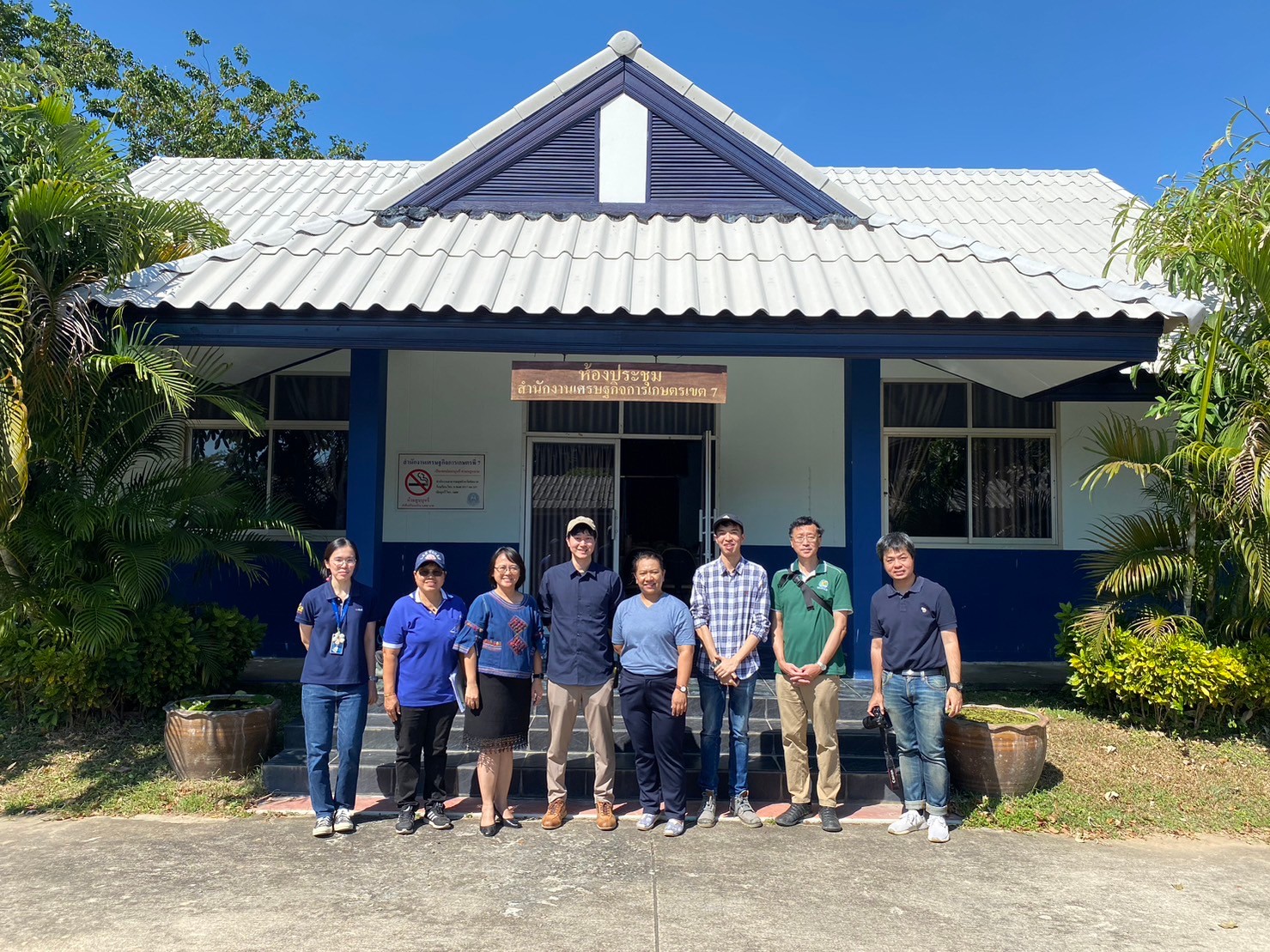
The Joint Research Meeting on 6 and 8 December 2023 and Site Visits on Rice Yield Estimation using Satellite Data on 7 December 2023 were conducted in Thailand with the cooperation of the Office of Agricultural Economics (OAE) of Thailand, Ministry of Agriculture, Forestry and Fisheries (MAFF) of Japan, Remote Sensing Technology Center (RESTEC) of Japan, and the AFSIS Secretariat.
The Objectives of the meeting and site visits were to learn detailed survey methods and the actual rice cultivation situation on the site for the development of rice yield forecasting method using satellite Meteorological Information project
On 6th December, Mr. Hosaka Masahiro, Deputy Director of the Statistic Planning Division, Statistic Department from MAFF, Japan, shared the project introduction followed by the representative of RESTEC, Mr. Junpei Yamamoto, shared the status and future plan
for the future project. The last session was presented by the representative from OAE on the introduction of statistical survey methodology and Crop-cutting Methodology in Thailand.


On 7th December, the AFSIS Secretariat with the collaboration of the Regional Office of Agricultural Economics 7 (ROAE 7) conducted a field survey at Ban Don Talai, Moo 6, Bang Luang Subdistrict, Sapphaya District, Chainat Province to organize a demonstration on crop-cutting in wet season rice (irrigated paddy fields). Additionally, a visit to a rain-fed paddy field outside the irrigation area at the Development of Agricultural Learning Center (ALC) in Nong Ma Mong District, Chainat Province.


On 8th December, a wrap-up meeting was held to review and summarize key findings from the field visit. Additionally, a discussion session was conducted to enhance understanding of the methodology for rice crop cutting and sampling survey.


The site visits were successfully ended with a great collaboration among the officials of ROAE 7, representatives from RESTEC, farmers, and AFSIS Secretariat. The knowledge imparted from this event will be used as supportive information and development for a pilot study on the development of rice yield forecasting methods using a satellite Meteorological Information project.

The AFSIS Secretariat participated in the 10th International Conference on Agricultural Statistics (ICAS X), held from 8 to 10 July 2026 at the ICE Krakow Congress Centre in Krakow, Poland. Jointly organized by Statistics Poland, Eurostat, the United States Department of Agriculture (USDA), the World Bank Group, and the Food and Agriculture Organization of the United Nations (FAO).
.JPG)
On 24–25 June 2026, AFSIS Secretariat participated in the 46th Meeting of the ASEAN Food Security Reserve Board (AFSRB) via a virtual conference. The Meeting was jointly organized by the AFSRB Secretariat and the Department of Agriculture (DOA), Ministry of Agriculture, Livestock and Irrigation (MOALI) of the Republic of the Union of Myanmar, and was hosted in Nay Pyi Taw, Myanmar.

On 17–18 June 2026, the 24th AFSIS Focal Point Meeting was successfully convened via video conference, hosted by the Philippine Statistics Authority (PSA) in collaboration with the ASEAN Food Security Information System (AFSIS) Secretariat.
.jpg)
The ASEAN Food Security Information System (AFSIS) Secretariat, in collaboration with the Ministry of Agriculture, Forestry and Fisheries (MAFF) Japan, Japan Aerospace Exploration Agency (JAXA), Remote Sensing Technology Center of Japan (RESTEC), and Geo-Informatics and Space Technology Development Agency (GISTDA), conducted the 2nd Hands-on Training Courses for Agricultural Statisticians, the Final Workshop, and the 2nd Seminar for Executive Officials under the JAIF Project entitled “Improvement of Rice Paddy Area Statistics and Damage Assessment using Earth Observation Satellites for ASEAN” in Sriracha, Chonburi Province, and Bangkok, Thailand.

