.png)
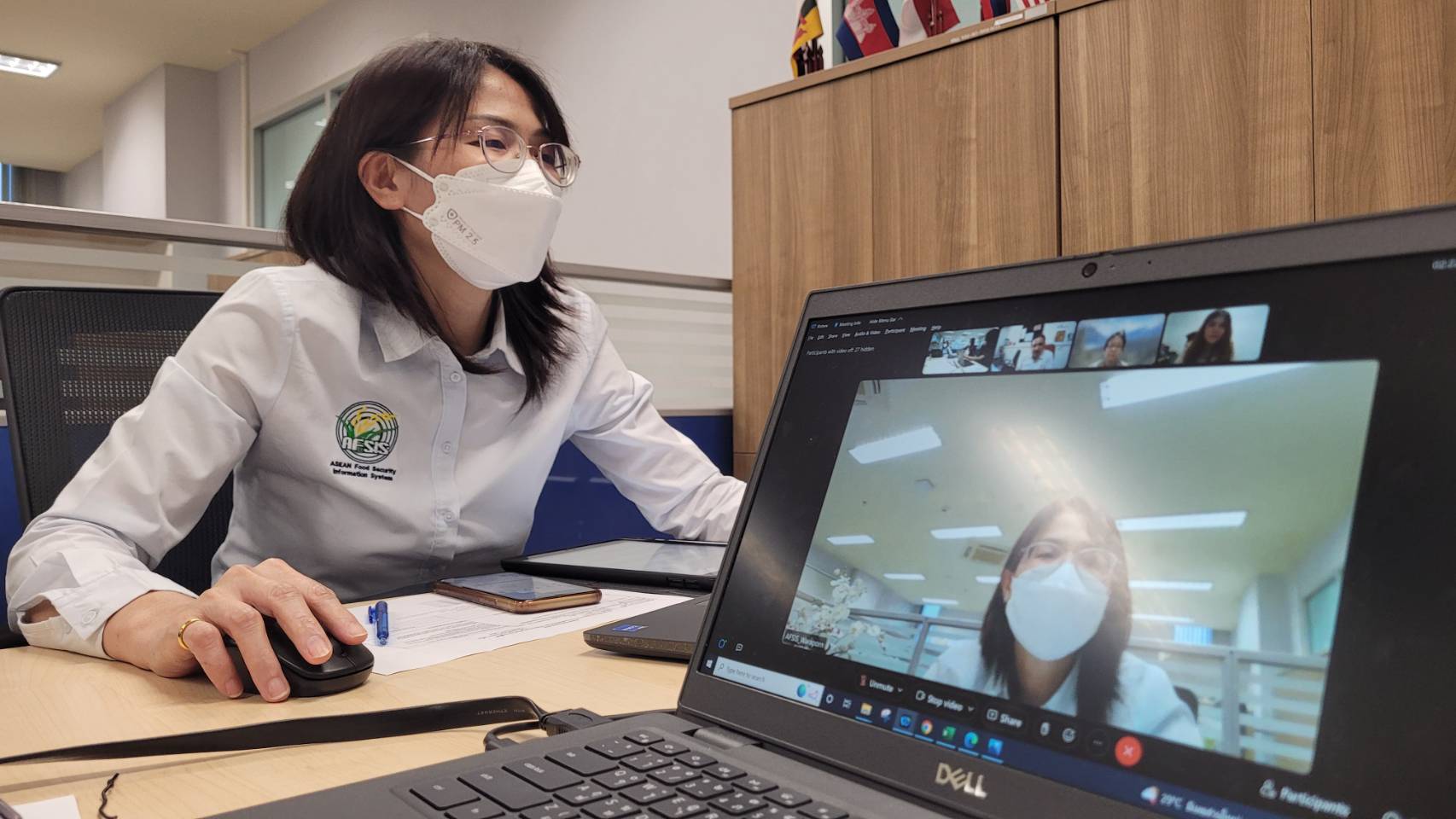
The Space Application on Environment (SAFE) with the collaboration of Japan Aerospace Exploration Agency (JAXA), Japan, the Indian Space Research Organization (ISRO) of India, Geo-Informatics and Space Technology Development Agency (GISTDA) of Thailand, and AFSIS Secretariat had conducted the Training Program on Satellite-Derived Agrometeorological Data for AFSIS’s Rice Growing Outlook (RGO) for Agriculture Management in the ASEAN on 11 July 2022 as a virtual program.
The representatives from AFSIS Secretariat included Dr. Waraporn Saelee, AFSIS Manager, Mr. Tanabodee Kheosipalard, Statistician, Ms. Worada Wongsud, Secretary to the Japanese Expert, and Ms. Prodpran Lomthong, Project Coordinator.
There were 26 trainees from 8 ASEAN member countries attending the training, namely Cambodia, Indonesia, Lao PDR, Malaysia, Myanmar, Philippines, Thailand, and Vietnam.
At the opening session, Dr. Waraporn Saelee delivered the welcome remarks and expressed her sincere gratitude and appreciation to all aforenamed agencies for their contribution to the training.
The objectives of this training program were to provide detailed training on the use of agromet data utilization with the SAFE Agromet project and to improve the capabilities in the interpretation of satellite-based agromet information to RGO activities.
During the training, there were remarkable lectures from Dr. Shashikant A Sharma, Er. Ujjwal Kumar Gupta and Dr. Rahul Nigam from ISRO regarding the demonstration of Indian Satellite derived agrometeorological information through the Meteorological & Oceanographic Satellite Data Archival Centre (MOSDAC), Python program, the Quantum Geographic Information System (QGIS), and Visualization of Earth Observation Data and Archival System (VEDAS). The trainees have learned step-by-step how to download data, data process, and generate the outputs using these programs.
The training was successfully conducted as the trainees were effectively imparted with the knowledge of agromet data utilization which can be applied to the RGO report and the agricultural statistics in their countries in the future.
.png)
.png)
.png)
.png)
.png)

The AFSIS Secretariat participated in the 10th International Conference on Agricultural Statistics (ICAS X), held from 8 to 10 July 2026 at the ICE Krakow Congress Centre in Krakow, Poland. Jointly organized by Statistics Poland, Eurostat, the United States Department of Agriculture (USDA), the World Bank Group, and the Food and Agriculture Organization of the United Nations (FAO).
.JPG)
On 24–25 June 2026, AFSIS Secretariat participated in the 46th Meeting of the ASEAN Food Security Reserve Board (AFSRB) via a virtual conference. The Meeting was jointly organized by the AFSRB Secretariat and the Department of Agriculture (DOA), Ministry of Agriculture, Livestock and Irrigation (MOALI) of the Republic of the Union of Myanmar, and was hosted in Nay Pyi Taw, Myanmar.

On 17–18 June 2026, the 24th AFSIS Focal Point Meeting was successfully convened via video conference, hosted by the Philippine Statistics Authority (PSA) in collaboration with the ASEAN Food Security Information System (AFSIS) Secretariat.
.jpg)
The ASEAN Food Security Information System (AFSIS) Secretariat, in collaboration with the Ministry of Agriculture, Forestry and Fisheries (MAFF) Japan, Japan Aerospace Exploration Agency (JAXA), Remote Sensing Technology Center of Japan (RESTEC), and Geo-Informatics and Space Technology Development Agency (GISTDA), conducted the 2nd Hands-on Training Courses for Agricultural Statisticians, the Final Workshop, and the 2nd Seminar for Executive Officials under the JAIF Project entitled “Improvement of Rice Paddy Area Statistics and Damage Assessment using Earth Observation Satellites for ASEAN” in Sriracha, Chonburi Province, and Bangkok, Thailand.

